Architectural Services
The Cold Truth: How the AI Data Center Boom Is Rewriting Architectural Design Rules
-
 Sreela Biswas
 - June 9, 2026
- 7:40 am

U.S.-based local architectural representation, ensuring communication, accountability, and delivery expectations, managed close to the client.
Explore more
Discover our architectural design excellence through a curated selection of projects.
Explore more
Take a look at how Uppteam can elevate your projects with expert engineering solutions.
Explore more
Our Structural Support Services can enhance your structural engineering projects with expert support.
Explore more
Uppteam delivers precise and reliable surveying and mapping solutions to help you make informed decisions.
Explore more
Whether you're working on residential, commercial, or industrial buildings..
Explore more
Uppteam’s Virtual Admin Support can help you with all your administrative tasks..
Explore more
Our experts work as your Second Eye Services expert.
Explore more Sreela Biswas
Beyond playing out in software, the AI revolution is physically reshaping the American built environment at a speed that most AEC firms have never faced. Nationwide, hyperscale data centers are rising faster than infrastructure can keep pace with, necessitating next-gen architectural thinking, site strategy, and systems integration. This is no longer a niche specialty. In 2024 alone, data center construction expenditure drove around 94% of all non-residential construction growth in the country. For AEC firms yet to fully realize this surge, this figure ought to serve as a sharp wake-up call.
The demand for AI infrastructure has pushed data center construction into genuinely historic territory. A McKinsey report estimates that meeting AI-powered compute demand could require between $3.7 trillion and $7.9 trillion in global data center capital investment over the coming decade. The International Energy Agency (IEA) reports that global data centers used approximately 415 TWh of electricity in 2024, which is roughly 1.5% of overall global electricity consumption, and projects that figure will likely double to 945 TWh by 2030.
For AEC professionals, the project-level numbers are equally compelling. A single hyperscale facility can span 100,000 to 300,000 square feet. Construction costs usually run $10 to $12 million per megawatt of IT load and, in constrained markets, can exceed $15 million. These are not normal commercial buildings. In fact, they are precision-engineered facilities that push the limits of architectural, MEP, and structural design in ways most project categories simply do not.
The environmental burden of AI data centers has become impossible to ignore, and it is directly shaping where new facilities get built. The average data center uses approximately 300,000 gallons of water daily for cooling. At the AI scale, that consumption escalates into a regional resource issue.
A 2025 research study published in the journal Patterns projects that the water footprint of AI systems alone could reach 312.5 to 764.6 billion liters, while their carbon footprint could range between 32.6 and 79.7 million tons of CO₂, which is equivalent to the yearly emissions of New York City. In 2024, Google’s environmental report corroborated a 13% year-over-year increase in greenhouse gas emissions, fueled mainly by data center energy consumption.
Beyond Carbon, a University of Cambridge preprint study examining satellite data from 2004 to 2024, discovered that large-scale AI data centers raise regional and surface temperatures by an average of 3.6°F, with some areas experiencing an increase as high as 16°F within a six-mile radius. These are much more than simple operational efficiency concerns; they are actually site planning, zoning, and architectural design issues that AEC teams must account for from the very beginning.
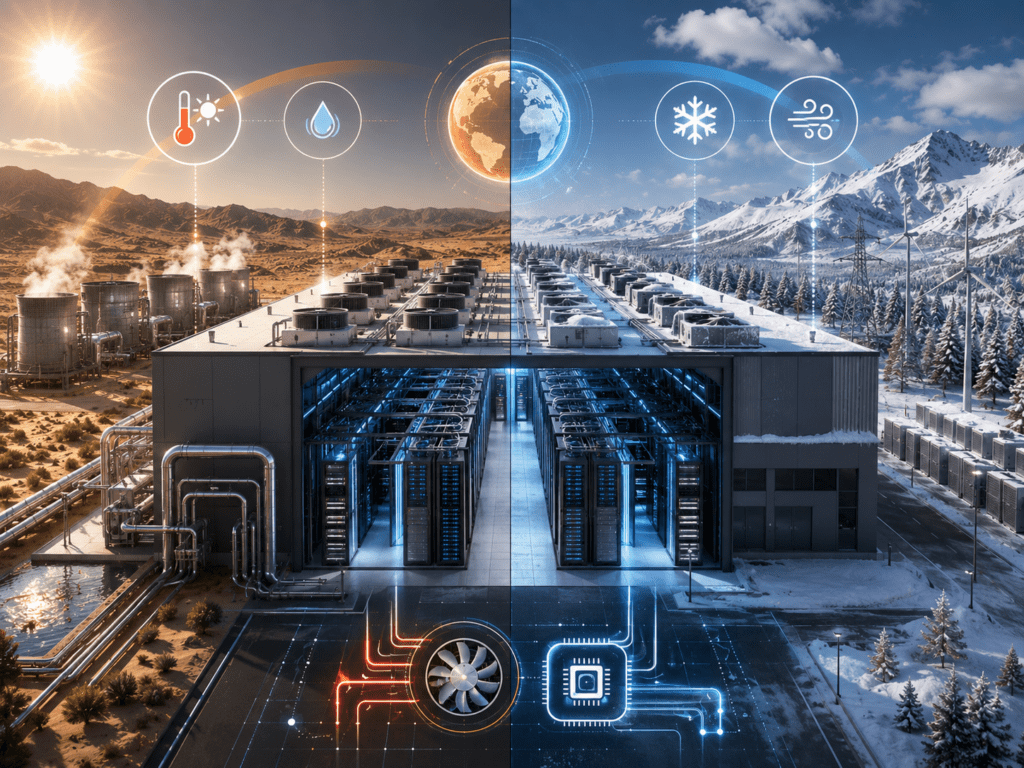
Cooling is the main operational cost challenge for every data center. In warm climates, facilities depend extensively on energy-intensive mechanical cooling and water-based evaporative systems. Cold climates present a whole new paradigm. By taking advantage of low ambient temperatures for free cooling, operators in naturally cooler areas can drastically cut both energy use and water consumption.
A recent industry analysis focused solely on data centers notes that a one-gigawatt plant in a cold climate could save upwards of $150 million annually compared to a comparable Texas facility. This can be achieved simply by eliminating a considerable portion of ancillary cooling requirements. Another industry assessment highlights that while a 10-megawatt facility in a hot country might consume tens of millions of liters of water every year, an equivalent data center in a cold climate using closed-loop systems can bring that down to just 10 to 20 cubic meters.
This operational logic is currently driving site selection choices throughout the United States, with milder temperatures, lower humidity, available land, and developing power infrastructure drawing hyperscale investment at a stunning pace.
In recent times, North Carolina has emerged as the nation’s most active data center development corridor. Technology giants like Google, Apple, Meta, and Microsoft operate substantial facilities west of Charlotte, motivated by the state’s cooler Piedmont climate, land availability, and Duke Energy’s grid capacity. Amazon’s Richmond County project broke ground late last year, with comprehensive build-out extending through 2027-2028. In Edgecombe County, a proposed hyperscale facility is designed for 900 megawatts of load, which is thirty times the scale of Meta’s existing Forest City facility.
South Carolina and Tennessee are also following an identical trajectory, offering a fusion of lower energy costs, reduced humidity, simplified permitting environments, and access to renewable energy. All of these factors can reduce the mechanical burden on data center cooling systems and cut back on long-term operational expenses for operators.
On the innovation side, Microsoft has announced that all new data center designs would have closed-loop, chip-level cooling that helps eliminate evaporative water use completely and save over 125 million liters of water per facility annually. These cooling technology shifts result in entirely new architectural and MEP design requirements that AEC teams have to be fluent in.
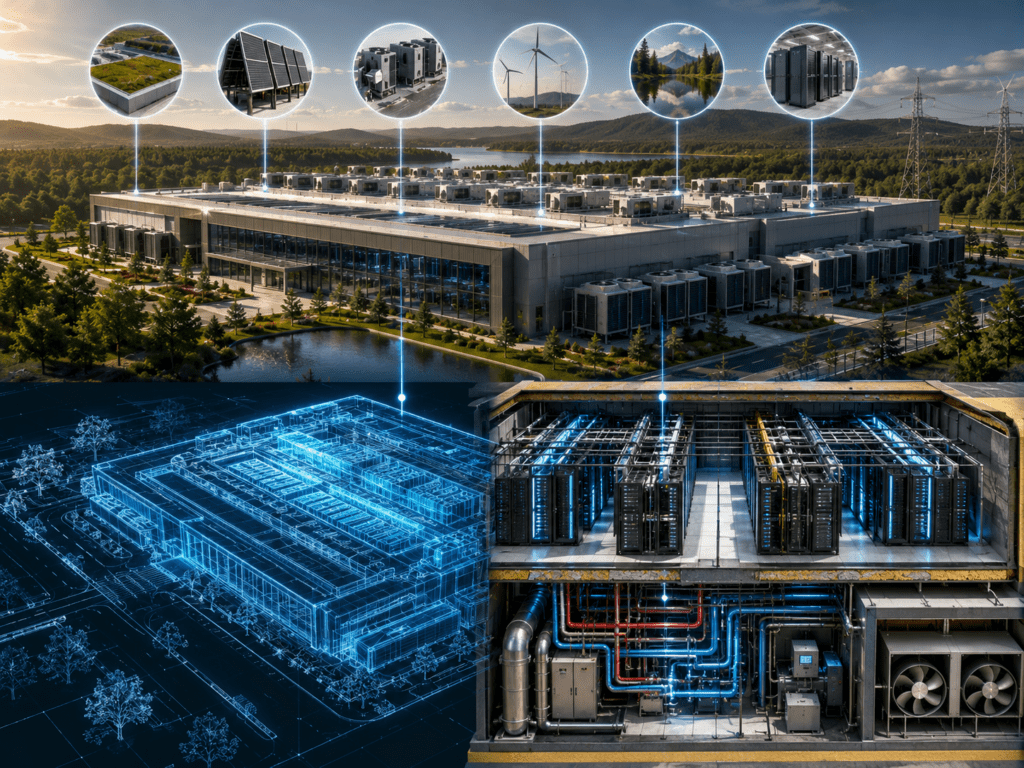
Here is where this storyline becomes directly pertinent for all US-based AEC firms. Data centers developed for AI workloads are categorically distinct from conventional commercial construction, and that difference begins with architectural design.
AI server racks weigh more than 3,300 pounds each. Hyperscale floor panels should bear loads of up to 3,000 kilograms per square meter, roughly double standard manufacturing code requirements. Structurally integrated MEP pathways, reinforced concrete foundations, raised floor coordination, and meticulously calculated ceiling heights for airflow management are uncompromising design requirements. Direct-to-chip cooling adds convoluted pipe infrastructure that needs to be coordinated from schematic design.
The cold climate shift comes with another layer of site-specific complexity. Thermal envelope performance, humidity control, exterior wall and roof assemblies, and heat recovery integration all mandate deliberate architectural decision-making at the earliest stage of the design process. Here, BIM coordination is the baseline for projects with this level of complexity.
HDR, one of the oldest and largest architecture and engineering consulting companies worldwide, reported a 200% increase in data center-related projects in a single year. At the same time, Corgan, another prominent architecture firm, more than doubled its data center revenues between 2020 and 2025, reaching $135 million.
The AEC firms winning in this space are, in fact, those who acknowledge and understand that data center architecture is a specialized discipline, one that rewards thorough technical fluency and fast, coordinated production capabilities.
The AI data center expansion is not just a passing market cycle. It is a radical infrastructure shift that will define commercial construction across the US for at least the next decade. So, for leading AEC firms, the question is whether they have the specialized knowledge and production capacity to do so at the pace and level of complexity that these projects demand.
uppteam is well aware of this shift, as we operate at the intersection of architectural expertise and technology-forward delivery. Our remote architectural design support solutions, encompassing CD production, life safety and ADA compliance, and 3D visualization, are purpose-built for the kind of high-complexity, high-speed work that AT data center construction demands. As we move towards a more AI-dependent environment in the coming years, uppteam’s architectural design depth and production scale are committed to delivering optimal results.