Architectural Services
Why Your Architectural Construction Documents Might Be Costing You More Than You Think
-
 Soumen
 - September 11, 2025
- 5:48 am

U.S.-based local architectural representation, ensuring communication, accountability, and delivery expectations, managed close to the client.
Explore more
Discover our architectural design excellence through a curated selection of projects.
Explore more
Take a look at how Uppteam can elevate your projects with expert engineering solutions.
Explore more
Our Structural Support Services can enhance your structural engineering projects with expert support.
Explore more
Uppteam delivers precise and reliable surveying and mapping solutions to help you make informed decisions.
Explore more
Whether you're working on residential, commercial, or industrial buildings..
Explore more
Uppteam’s Virtual Admin Support can help you with all your administrative tasks..
Explore more
Our experts work as your Second Eye Services expert.
Explore more Soumen
Most developers, contractors, and design teams typically attribute expense overruns to material price hikes, labor shortages, or unexpected site conditions. Seldom do they examine how a significant portion of wasted resources originates much earlier in the process—during the construction documents (CDs) phase.
Poorly coordinated or incomplete CDs quietly erode budgets, leading to inflated bids, unnecessary change orders, and delays that cascade through entire projects. The Construction Industry Institute (CII) consistently identifies errors and omissions in design documentation as among the top contributors to project overruns. Recent studies have shown that 52% of construction projects experience significant delays due to inadequate documentation. Yet many firms underestimate how costly this “paper stage” becomes when mishandled.
Recent industry analysis reveals where these hidden costs originate and demonstrates how comprehensive architectural design approaches can deliver substantial savings across project lifecycles.
Contractors base their proposals on the quality of the available information. When CDs lack clarity or detail, bidders consistently pad their numbers to account for uncertainties. Missing wall assembly specifications, vague structural notes, or unclear MEP layouts force contractors to use worst-case-scenario pricing.

Industry veterans frequently note: “Projects don’t pay for change orders—they pay for mistakes in the drawings.” When construction documents lack completeness or coordination, change orders multiply rapidly.
Common scenarios include:
Each oversight demands time and resources to resolve.
Municipal jurisdictions are tightening review standards for construction documents (CDs).
Incomplete CDs often stall in approval cycles due to:
Each round of resubmission can waste weeks or months, leading to the accumulation of carrying costs (e.g., construction financing interest)Data from major urban areas indicate that projects with complete, code-compliant initial submissions receive approvals on average 40% faster than those requiring multiple revisions.
Well-prepared CDs anticipate regulatory scrutiny and lead to smoother approval processes.In contrast, insufficient documents lead to preventable delays, costing clients.In Houston, permit resubmission delays cost the construction industry an estimated $180 million annually in extended financing and overhead costs.
Lack of integration between architectural, structural, and MEP designs leads to site teams managing conflict resolution. Field coordination is often more expensive and less efficient than resolving issues digitally during design phases. Example:
Industry data indicates:
Construction documents represent more than just technical drawings. They embody the design team’s professionalism. Inconsistent or error-prone CDs undermine client confidence, prompting questions about fees, timelines, and partner selection. Rebuilding damaged trust often costs more in terms of time investment, fee concessions, or reputational repair than producing accurate CDs initially.
Client retention studies in the AEC industry show that firms delivering consistently high-quality documentation maintain 30% higher client retention rates and generate 18% more repeat business compared to those with inconsistent CD quality.
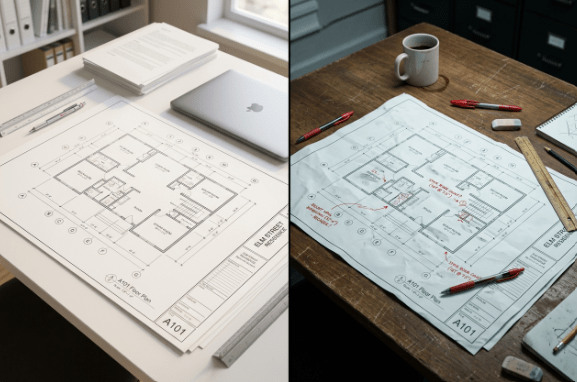
The construction industry is starting to see that fragmented design support often results in poor construction documents. While AI-driven outsourcing may lower initial costs, it typically raises long-term costs. It happens because of misaligned outputs and broken coordination.
Futuristic firms are adopting integrated architectural design solutions that enable planning, design development, coordination, and CD production to flow within unified frameworks.
This comprehensive approach transforms cost equations through several mechanisms:
Integrated Workflows: Design teams ensure that architectural, structural, and MEP inputs are reconciled before CD finalization, reducing field conflicts by up to 60%.
Code-Compliant Submissions: Every document set undergoes review against local codes and permitting requirements, minimizing resubmission delays and associated carrying costs.
Detail-Rich Documentation: Clear specifications and coordination reduce contractor uncertainty, lowering bid inflation while improving construction predictability.
Proactive Conflict Resolution: Digital conflict identification and resolution eliminate costly on-site corrections, with studies showing 3:1 cost savings compared to field fixes.
Enhanced Client Confidence: Complete, professional document sets reinforce trust, reduce project friction, and support long-term client relationships.
Market pressures often encourage cost-cutting in CD, particularly with the increase of AI tools and fragmented outsourcing options. However, industry analysis consistently demonstrates that every dollar saved in documentation quality costs three to five dollars during construction phases.
Recent case studies across commercial, industrial, and residential assignments show that comprehensive, accurate, well-coordinated CDs deliver:
Investment in thorough documentation doesn’t just purchase drawings—it secures predictability, efficiency, and measurable long-term savings.
When construction projects go over budget or face delays, the problem often goes beyond just materials and labor costs. Sometimes, the construction documents can end up being more expensive than expected. However, if managed strategically, these documents can help make projects smarter, quicker, and cheaper.
A key factor in construction success is choosing between two types of documentation: one fragmented and focused solely on costs, and another comprehensive and integrated. As profit margins get tighter and client expectations grow, this choice will become more important for ensuring project success.