All About A/E Staff
Construction Cost Updates: Market Insights 2024
-
 ajay tribhuwan
 - April 28, 2024
- 7:48 am

U.S.-based local architectural representation, ensuring communication, accountability, and delivery expectations, managed close to the client.
Explore more
Discover our architectural design excellence through a curated selection of projects.
Explore more
Take a look at how Uppteam can elevate your projects with expert engineering solutions.
Explore more
Our Structural Support Services can enhance your structural engineering projects with expert support.
Explore more
Uppteam delivers precise and reliable surveying and mapping solutions to help you make informed decisions.
Explore more
Whether you're working on residential, commercial, or industrial buildings..
Explore more
Uppteam’s Virtual Admin Support can help you with all your administrative tasks..
Explore more
Our experts work as your Second Eye Services expert.
Explore more ajay tribhuwan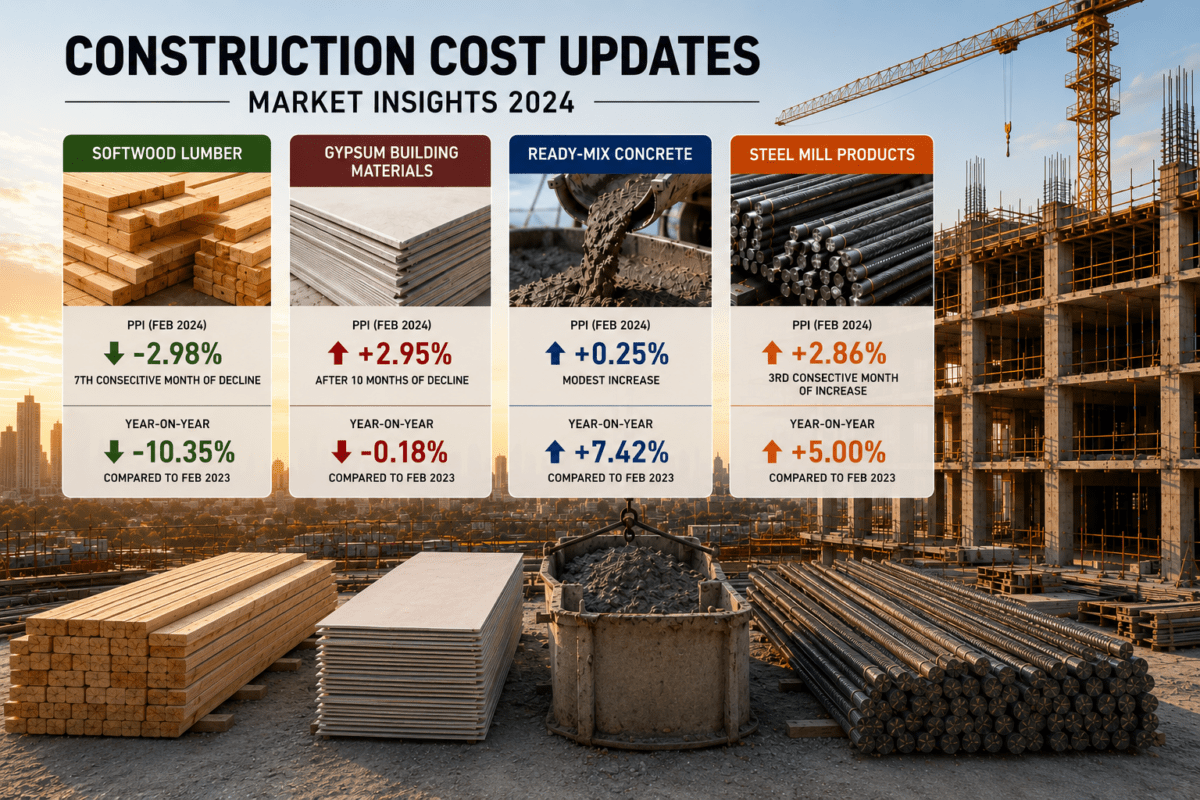
Construction costs are a critical factor in the planning and execution of any building project. Keeping track of market trends and price fluctuations in construction materials is essential for developers, contractors, and material suppliers alike. Here are the latest updates based on the Producer Price Index (PPI) data for 2024:
Softwood lumber is a fundamental construction material used extensively for framing and structural applications.
In February, the seasonally adjusted PPI for softwood lumber decreased by 2.98%. This marks the seventh consecutive month of decline, reflecting ongoing market trends.
Compared with the previous year, softwood lumber prices were down 10.35% in February 2024. This significant decrease may impact budgeting and procurement decisions for upcoming projects.
Gypsum building materials, including drywall and plaster products, play a vital role in interior construction.
After 10 consecutive months of decline, the non-seasonally adjusted PPI for gypsum building materials rose 2.95% in February. This upturn warrants close supervision of procurement decisions for interior finish packages in Q2 2024.
Despite the recent increase, the index remains 0.18% lower compared to the same period last year. Understanding this trend is crucial for anticipating future price movements and managing project costs effectively.
Ready-mix concrete is a key component in various construction projects, offering convenience and consistency.
In February, the seasonally adjusted PPI for ready-mix concrete showed a modest increase of 0.25%. While this rise is relatively small compared to previous months, it still contributes to overall cost considerations.
Compared to the previous year, prices for ready-mix concrete were 7.42% higher in February 2024. This upward trend has direct implications for foundation and structural slab budgets in ongoing procurement.
Steel mill products are essential for structural support and fabrication in construction projects.
The non-seasonally adjusted PPI for steel mill products rose by 2.86% in February, marking the third consecutive month of increase. This upward trajectory reflects broader economic factors influencing the steel industry.
Compared to the previous year, steel mill product prices surged by 5.00% in February 2024. This steady growth may pose challenges for budget allocation and project scheduling.

For developers, the divergence between softwood lumber’s 10.35% year-on-year decline and ready-mix concrete’s 7.42% increase leads to meaningful trade-offs in choosing structural systems and contingency budgeting for 2024 project pipelines.
For general contractors, steel mill products’ third consecutive month of PPI increase necessitates escalation clause reviews in active subcontractor agreements and early procurement tactics for structural steel packages.
Material suppliers need to adapt production timelines and inventory management to evolving demand and pricing dynamics. Monitoring PPT data facilitates more accurate output planning and minimizes exposure to margin compression during price swings.
The 2024 updates in construction material prices offer valuable insights for stakeholders across the industry. From softwood lumber to steel mill products, understanding these trends enables informed decision-making and proactive risk management.
Uppteam’s remote design and BIM support specialists work directly within your project operations. This approach provides construction documentation, cost-informed design modifications, and material specification support customized to current US market conditions. Book a consultation to discuss how we can support your upcoming projects’ cost management and documentation requirements.