Architectural Services
How Commercial Flooring Is Reshaping Architectural CD Set Production
-
 Sreela Biswas
 - June 11, 2026
- 10:24 am


U.S.-based local architectural representation, ensuring communication, accountability, and delivery expectations, managed close to the client.
Explore more
Discover our architectural design excellence through a curated selection of projects.
Explore more
Take a look at how Uppteam can elevate your projects with expert engineering solutions.
Explore more
Our Structural Support Services can enhance your structural engineering projects with expert support.
Explore more
Uppteam delivers precise and reliable surveying and mapping solutions to help you make informed decisions.
Explore more
Whether you're working on residential, commercial, or industrial buildings..
Explore more
Uppteam’s Virtual Admin Support can help you with all your administrative tasks..
Explore more
Our experts work as your Second Eye Services expert.
Explore more Sreela Biswas
Commercial flooring has matured far beyond simple finish material selection. Throughout the US AEC industry, flooring choices are successively influencing sustainability objectives, occupant wellness strategies, acoustic performance requirements, maintenance planning, and construction sequencing. Accordingly, flooring specifications now impact much more than just aesthetics. They explicitly affect how architectural construction document packages are developed, coordinated, and handed over.
In 2024, the US commercial flooring market reached $158 billion, and it is projected to reach $195 billion by the end of 2030. Behind this astonishing growth lies a fast-evolving catalog of materials, assemblies, and performance requirements. Every new specification choice generates documentation accountabilities that flow directly into the architectural CD set.
When AEC firms treat flooring as a downstream procurement decision, they consistently find that drawings lag behind design intent and permit submissions fall short. The firms involved in high-quality commercial work today acknowledge that flooring decisions prompt more drawing production scope than any other single interior system in complex commercial endeavors.
There are three forces simultaneously advancing flooring specifications beyond the reach of standard finish schedules.
Multi-material floor systems have become the commercial design foundation. Healthcare campuses, offices, retail buildings, and educational facilities now combine LVT, polished concrete, carpet tile, rubber, and resinous terrazzo-look systems within a single floor plate. Every material transition necessitates its own construction document detail, substrate specification, threshold type, and ADA compliance verification.
Sustainability documentation requirements have also extended notably alongside material diversity. LEED projects mandate architects to specify and document low-VOC adhesives, Environmental Product Declarations, and recycled content percentages for all floor materials, coordinated throughout specification sections and drawing annotations.
Performance standards currently carry code force. According to the International Building Code 2024, minimum IIC and STC ratings of 50 for floor-ceiling assemblies between dwelling units in hospitality and multifamily buildings are now mandatory. This directive alone forces architects to document the full acoustic assembly configuration across several drawing sheets, not just list finish materials on a schedule.
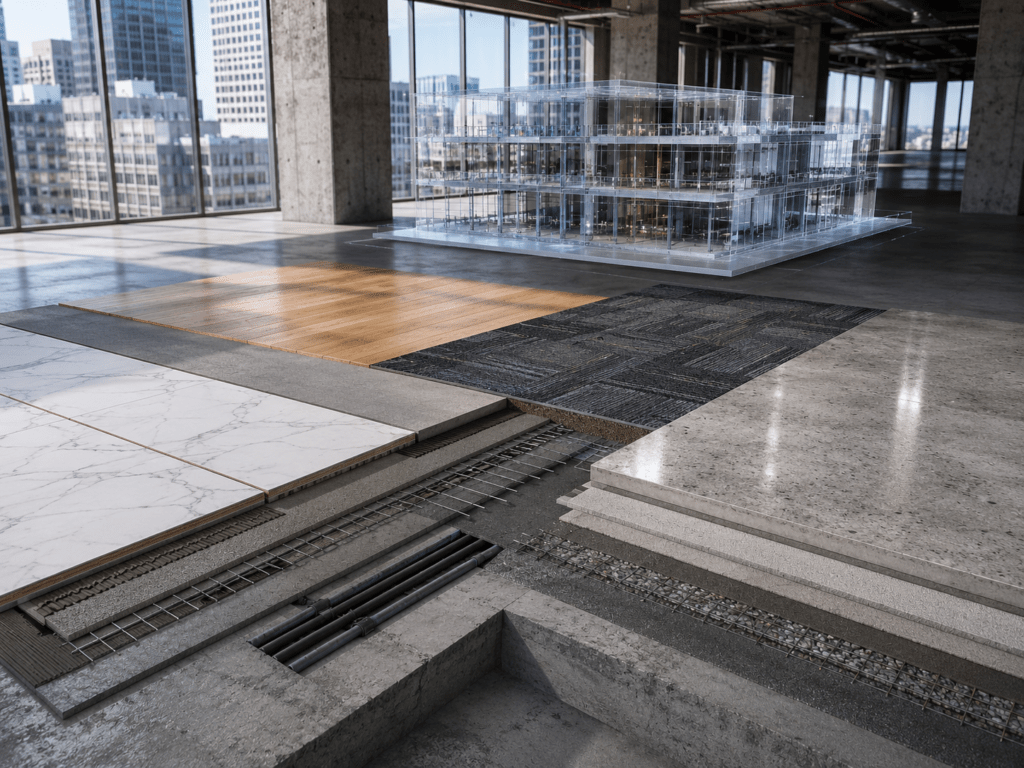
At present, four commercial flooring trends are dominating the construction sector, where each generates diverse documentation additions within architectural CD packages. Spotting these implications at project outset is helpful in effectively preventing production bottlenecks during later design stages and facilitates project teams in allocating drawing production resources precisely from the beginning.
LVT captured approximately 49.5% of the US resilient flooring market in 2024. Its moisture sensitivity necessitates architects to specify vapor emission rates, ASTM F710 flatness tolerances, and adhesive compatibility within specialized specification sections that prior standard systems never needed.
As open-plan offices and multifamily construction conquer new commercial production, acoustic underlayment selection now comes with structural documentation consequences. Ideal underlayment selection can boost IIC performance by 10 to 20 points, and obtaining those results calls for precise assembly thickness documentation, substrate preparation specifications, and transition conditions at each room boundary.
Biophilic design has fostered sustained demand for nature-inspired mixed-material floor layouts across retail, office, and healthcare projects. Every zone change contributes to a floor plan annotation, a transition detail, and a finish schedule entry. A single floor plate blending polished concrete, wood-look LVT, and carpet tile can demand six or more different drawn details to clarify correctly.
Terrazzo and resinous micro-terrazzo systems have made a strong comeback across the hospitality and institutional sectors. These systems need ACI 302.1R-compliant substrate documentation, crack isolation membrane specifications, and expansion joint plans, seamlessly coordinated with structural drawings.
Every single trend listed above results in quantifiable additions to architectural CD set production scope. A commercial project that once specified a single carpet system may presently need a floor finish plan, a floor pattern plan, several transition details, a substrate preparation schedule, an acoustic assembly schedule, and annotated protocols covering EPD documentation, VOC compliance, and installation qualifications.
The specification burden has scaled alongside the drawing burden. CSI MasterFormat Division 09 flooring specifications often span multiple subsections encompassing tile, resilient, wood, carpet, terrazzo, and specialty coatings, each with varying performance, substrate, and warranty requirements that should align with the drawing set.
ADA compliance criteria add an extra layer of coordination. Under the existing accessibility standards, vertical floor level changes cannot surpass 6.35 mm vertically or 13 mm when beveled. Architects who specify multiple finish assemblies with varying thicknesses within a single project must document every threshold condition with ADA precision, which requires systematic detail production at scale.

Flooring documentation does not come down to a single schedule sheet. Producing a code-adherent, contractor-ready flooring set requires architects to yield and coordinate multiple distinct deliverables, where each carries its own technical demands. Understanding this particular scope at project outset is key to accurate fee structuring and production planning.
A comprehensive flooring CD set usually includes the following elements:
A fully dimensioned plan sheet that identifies each material zone across the floor plate, with keynotes connected to the finish schedule.
A tile setting or plank orientation plan that specifies module size, grout joint width, starting reference points, and directional changes at transitions.
Individually drawn details for each material change condition, flooring-to-base junction, and door threshold in coordination with ADA vertical change limits.
A tabulated schedule that lists the manufacturer, product name, series, color, finish, and application zone for all flooring materials in the project.
For applicable occupancy classifications under IBC 2024, a documented floor-ceiling assembly configuration demonstrating compliance with minimum IIC 50 and STC 50 ratings.
CSI Division 09 specification sections that address moisture vapor emission testing, slab flatness tolerance levels per ASTM F710, and adhesive or primer compatibility requirements.
Each one of these components connects to the others. An alteration in one flooring zone updates the schedule, the finish plan, the transition details, and specifications concurrently. This interconnection is exactly where production complexity exacerbates in projects with multi-material floor systems.
Commercial flooring specification has become a defining factor in modern architectural CD set production. It informs finish plan development, transition details, substrate specifications, acoustic assembly schedules, and sustainability documentation. All of these components must appear in coordinated, code-compliant sets delivered within accelerated timelines. As regulatory requirements and material diversity keep expanding, the production burden on architectural teams will only intensify.
uppteam’s architectural offshore production (AOP) service deals with this demand directly. Our production teams work within a firm’s CAD and Revit standards to create construction documents at the speed and technical depth that contemporary commercial projects need, including the growing volume of flooring-related drawings that progressively define project complexity.
For AEC businesses confronting rising CD production scope without scalable internal capacity, uppteam offers the technical rigor and delivery consistency to close that gap reliably. Firms seeking to scale without jeopardizing drawing quality will find in uppteam a trusted production partner aligned with where commercial architecture is heading.