Uppteam

  • Training

Structural Design and Modeling of a Garage Extension in Seattle

  • Sreela Biswas
  • October 8, 2025
  • 11:06 am
Project Type: Residential
Software: Forte Web, Tekla Tedds, AutoCAD
Project Duration: 3 weeks

Task Assigned

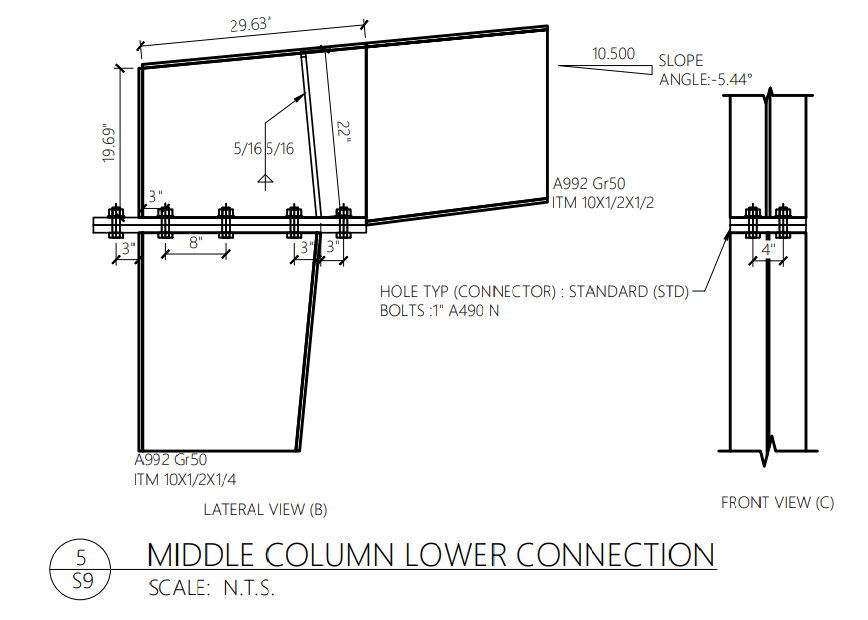
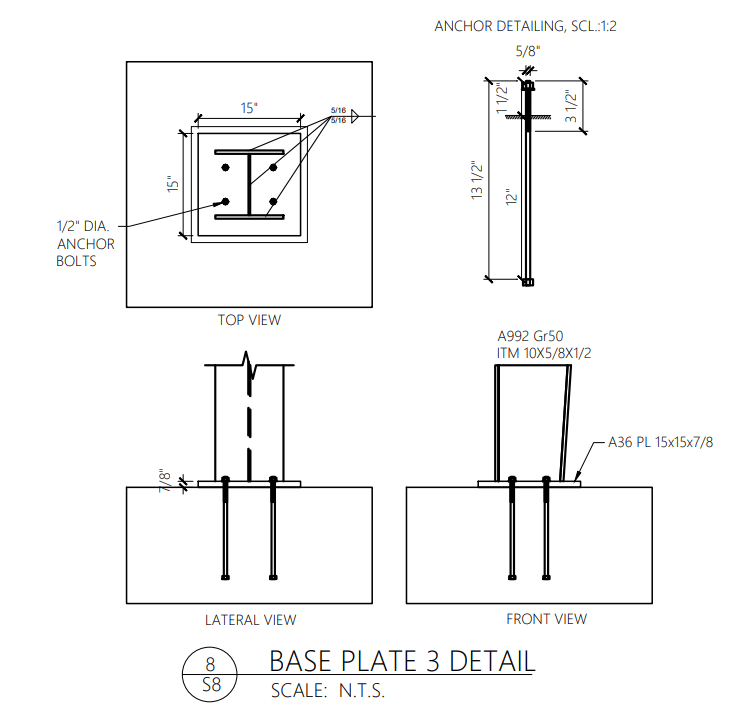
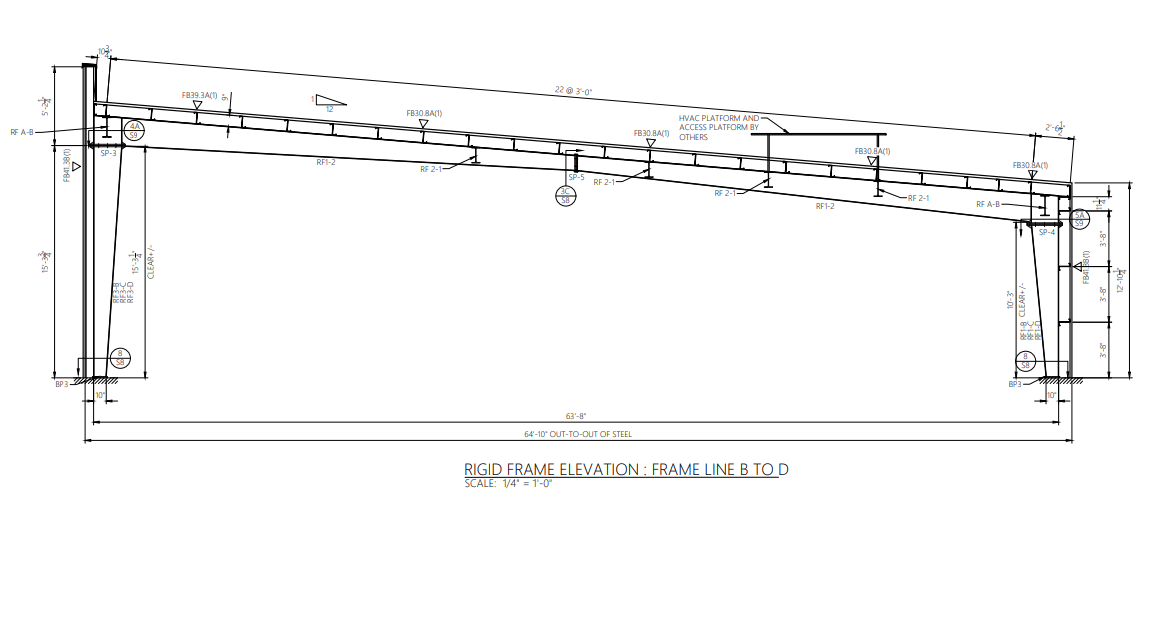
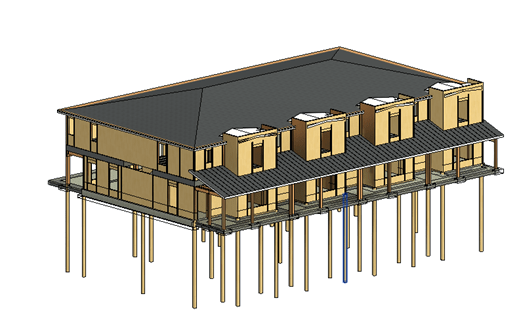
Uppteam was engaged to provide complete structural design and modeling support for a garage extension project in Seattle. The project required partial demolition of the existing structure and construction of a new garage integrated with the original building, including roof and attic framing, foundation plans, and detailed structural layouts. We coordinated with architectural and MEP teams to ensure accuracy and constructability.

Project Timeline

  • Week 1: Site Assessment & Demolition PlanningConducted a detailed review of the existing garage structure and identified areas requiring partial demolition. Prepared foundation layouts and demolition sequencing to maintain stability and minimize impact on adjacent structures.
  • Week 2: Structural Design DevelopmentDeveloped roof and attic framing plans based on design loads and architectural requirements. Structural elements were analyzed using Forte Web and Tekla Tedds to ensure code compliance and efficiency.
  • Week 3: Detailing & CoordinationFinalized framing and foundation details and collaborated with architectural and MEP teams to resolve design conflicts. Prepared construction-ready drawings with explicit annotations and references.

Additional Notes

  • The existing garage required partial demolition without compromising the stability of adjoining structures. We developed a phased demolition and reinforcement plan to maintain structural integrity during the construction process.
  • Ensuring coordination among structural, architectural, and MEP elements through regular reviews and clash checks to align designs and prevent rework.
  • We delivered the project on time with a well-coordinated garage extension that met the architectural intent. Our design minimized on-site conflicts and streamlined the client’s construction workflow.

Why Some Structural Design Lasts Forever While Other Projects Fall

  • Sreela Biswas
  • October 3, 2025
  • 8:09 am

Consider the Mackinac Bridge in Michigan, built in 1957; it still carries thousands of vehicles daily across brutal weather conditions. Compare that to highway overpasses from the 1980s that already need significant repairs. The difference isn’t just age or materials, though both play a role.

The honest answer lies in how structural engineers tackle the fundamental challenges of building something meant to last decades. After examining projects ranging from subway systems to international airports, several key principles emerge that separate successful infrastructure from projects that struggle.

The Real Challenge: Planning for the Unpredictable

Load calculations seem straightforward until you examine the details. Everyone knows a bridge must carry traffic. But how do you account for that January ice storm adding 30% more weight than worst-case scenarios? Or the reality that trucks keep getting heavier despite regulations?

Engineers working on Denver International Airport’s terminal had to account not just for normal passenger loads, but for mass flight cancellations where thousands might be stranded for hours. Add ground vibrations from aircraft, wind loads on that massive roof, and thermal expansion across hundreds of feet – suddenly, “simple” load calculations become incredibly complex.

Safety margins in these projects can be surprising. Highway bridges often get designed for loads 2-3 times heavier than typical traffic suggests. That might look like waste, but it’s actually what keeps structures functional when reality exceeds expectations.

Redundancy takes this thinking further. Smart infrastructure doesn’t assume every component stays perfect forever. Cable-stayed bridges exemplify this – lose one cable, others redistribute the load automatically. It’s an elegant problem-solving based on the acceptance that material fatigue and unexpected stresses occur.

Resilience has become critical as weather patterns grow less predictable. Strong structures resist disaster, but resilient ones recover quickly. The difference between reopening a highway in days versus months can determine whether communities bounce back or face prolonged economic damage.

Learning from Spectacular Successes and Failures

Japan’s earthquake-resistant bridge design offers compelling lessons. Rather than building stiffer, “stronger” structures, Japanese engineers embraced flexibility. Their bridges sway and shift during seismic events, then return to their original position. Results speak volumes – flexible designs survive while rigid ones suffer catastrophic failure.

Airport terminals present different challenges entirely. Atlanta’s Hartsfield-Jackson handles over 100 million passengers annually. The structural engineering quietly manages incredible complexity: terminal roofs spanning hundreds of feet, floors enduring constant aircraft vibration, and climate control across enormous volumes. Solutions typically blend materials, such as steel for flexibility, concrete for stability, and composites where weight reduction is most critical.

The Øresund Bridge, connecting Denmark and Sweden, faced unusual constraints: eight kilometers of open water, constant ship traffic, ice loads, saltwater corrosion, and two different national building codes. The final bridge-tunnel combination demonstrates creative engineering while respecting structural fundamentals.

Meanwhile, hurricane-prone regions, such as the Gulf Coast, have developed their own specialized approaches. The I-10 Twin Span Bridge replacement after Hurricane Katrina incorporated lessons learned the hard way, including precast concrete segments that can withstand 150+ mph winds and foundation systems driven 200+ feet deep into soft delta soils. Cost overruns were significant, but the alternative —losing critical transportation links for months after every major storm —proved far more expensive.

Materials Revolution Changing Everything

Today’s materials aren’t what engineers used 40 years ago. Advances in chemistry and manufacturing are redefining possibilities.

High-performance concrete now achieves strengths once considered impossible while resisting deterioration far longer. For infrastructure, this means lower lifecycle costs and fewer disruptive repairs.

Corrosion-resistant steel alloys have transformed projects in coastal and northern climates, where salt causes havoc. Higher upfront costs pay back multiple times as structures remain intact decades longer.

Composite materials push design boundaries further. Carbon-fiber reinforced polymers offer remarkable strength-to-weight ratios, enabling longer spans and unusual geometries. The recently completed Queensferry Crossing in Scotland utilizes CFRP stay cables that are 20% lighter than their steel equivalents, while lasting twice as long in harsh marine conditions. Cost still limits widespread adoption, but projects like this prove their value in extreme environments.

Ultra-high-performance concrete (UHPC) is appearing in more projects. With compressive strengths exceeding 22,000 psi—compared to 4,000 psi for conventional concrete —it enables thinner sections and longer spans. The challenge isn’t technical capability anymore; it’s convincing budget-conscious agencies to pay premiums for materials that save money over 50-year lifecycles.

Digital Revolution in Structural Design

Building Information Modeling (BIM) brings architectural, structural, and mechanical systems into a shared digital environment, where changes in one system are immediately visible across all disciplines. Fewer construction surprises, fewer costly field conflicts.

Finite Element Analysis pushes simulation capabilities to new levels. Instead of testing one or two scenarios, engineers evaluate thousands: different load combinations, stress concentrations at specific connections, long-term fatigue patterns, even failure modes. Results aren’t just stronger designs, but smarter ones.

Real power comes from timing. Identifying weak points and testing alternatives early allows for changes when they’re still inexpensive – before concrete pours or steel fabrication begins.

Artificial intelligence is starting to influence structural optimization. Machine learning algorithms can now evaluate millions of design variations to find optimal configurations that human engineers might never consider. The Heatherwick Studio’s design for the new Google headquarters utilized AI-assisted structural optimization to create column-free spaces spanning over 200 feet – a feat that would have taken months of manual iteration just a few years ago.

Managing Complex Project Realities

Large infrastructure projects rarely go smoothly. Timelines compress, complexity grows, internal teams stretch beyond limits. Risk isn’t just burnout – it’s errors rippling across entire projects.

Many firms turn to specialized design support during critical phases of their operations. Uppteam collaborates with structural engineering teams, providing additional modeling capacity when workloads spike, detailed simulations to reduce rework, and documentation support to streamline construction handoffs.

Uppteam’s approach extends rather than replaces expertise, giving core teams bandwidth for innovation and leadership while ensuring design details remain accurate and construction-ready.

What’s Coming Next

Infrastructure represents society’s longest-term investments. Done right, structures serve generations. Done poorly, they drain resources for decades.

Current combinations of proven principles, advanced materials, and powerful digital tools create unprecedented opportunities. With climate change driving new risks and demands, these capabilities arrive at precisely the right moment.

Future infrastructure success will belong to projects combining wisdom with innovation – structures that are strong, safe, adaptable, and sustainable. Communities deserve nothing less, and structural design guided by these principles can deliver it.

The next decade is likely to see increased integration between traditional structural engineering and emerging technologies, such as IoT sensors, for real-time monitoring and predictive maintenance. Bridges equipped with fiber optic strain sensors can now alert operators to potential problems years before they become visible. It’s a shift from reactive maintenance to predictive management – exactly what aging infrastructure needs as replacement costs continue climbing.

Structural Engineering for Modular Construction: Rethinking Load Paths and Connections

  • Soumen
  • September 18, 2025
  • 11:23 am

Undoubtedly, modular construction is among those components that are transforming the construction sector. It comes with expedited timelines and cost savings. Yet, this approach brings unique challenges, especially in terms of structural engineering. One of the key aspects here is to understand and handle load paths and connections. These factors are essential for guaranteeing the stability and safety of modular structures.

Load paths are usually straightforward in conventional construction. Here, gravity loads transfer directly from the roof through the walls to the very foundation. In contrast, modular construction encompasses pre-fabricated units, transported and assembled on-site. It necessitates meticulous planning of how loads should be transferred between modules and to the foundation. Indeed, this process is a complex one and calls for a rethinking of traditional structural design practices.

This blog taps into the significance of reimagining load paths and connections in modular construction. This exploration will enable AEC professionals to enhance the safety, effectiveness, and longevity of modular buildings.

Load Path Basics in Modular Construction

The foremost thing to remember about modular construction is that each module is formulated to carry specific loads. They involve dead loads, live loads, and environmental loads like wind and seismic forces. The load path is basically the route these forces take from the starting point to the ground. 

While this path is usually vertical in conventional buildings, modular buildings have more complex load paths. This is primarily because of both horizontal and vertical connections between modules.

Keep in mind that having a continuous and unbroken load path is key to the structural integrity of the building. Even a minor disruption in this path can result in uneven load distribution. The result is structural failure. Thus, thoughtful planning and error-free execution are necessary to sustain the integrity of load paths in modular construction.

Therefore, there is something fundamental that every structural engineer needs to understand. They need to redesign load distribution techniques to fit the innate discontinuities that individual modular units create. Besides, they should also ensure sufficient structural redundancy simultaneously. Bear in mind that load paths in modular systems depend extensively on inter-module connections rather than continuous structural members.

Modular units utilize light steel sections in wall assemblies to move loads vertically and horizontally using connection points. Consequently, engineers must calculate load paths that consider transportation stresses, assembly loads, and lifting forces. Cautious coordination is thus crucial to ensure ideal alignment and load transfer.

Moreover, dynamic analysis is crucial when a sudden module loss leads to alternative load paths, ensuring structural stability. Utilizing finite element analysis, experts can study stress movements during failure or removal. This enables them to design solutions that prevent collapse and ensure the structure functions effectively under both normal and extreme conditions.

Inter-Module Connection Systems and Performance

  • Connection design controls overall structural performance. This is because individual modules rely entirely on connection integrity for load transfer between adjoining units.
  • Horizontal connections allow lateral load distribution across several modules. They also help maintain structural continuity during wind or seismic events.
  • Vertical connections shift gravity loads between stacked modules. They also provide sufficient rigidity to stop additional deflections or instability.
  • Modular connections should support manufacturing tolerances and provide stable load transfer capacity under diverse loading conditions.

Obviously, the design and positioning of these connections ought to be meticulously planned to guarantee their ideal alignment and functioning. However, one must acknowledge that inter-module connections demonstrate the most critical structural components in modular construction. The reason behind this is that they influence how loads redistribute throughout building systems.

Clearly, traditional connections require changes for modular assembly. Here, bolted connections are more practical compared to field welding. Flexible connections considerably impact building performance during lateral loads.

Unquestionably, connection accessibility is a key challenge in modular construction. The reason? Interior connections become tough to install following module placement. As a result, professionals develop advanced solutions to ensure stable connections without hampering module integrity. These solutions may involve plug-in devices and hidden bolts. While cast plug-ins can tackle horizontal alignment, high-tensile bolts can control vertical load transfer between stacked modules.

Structural Redundancy and Alternate Load Path Analysis

It is vital to understand that modular buildings require detailed alternate load path analysis. The purpose of this is to remain stable when a module fails or is removed. This analysis approach assists engineers in assessing how the structure responds to damaged key elements, guaranteeing that the building is still within safety limits.

Dynamic analysis helps comprehend how loads shift when modules disappear abruptly. Additionally, designing for progressive collapse resistance is imperative, since module removal can contribute to serious failures. Structural redundancy makes sure that loads move through backup paths. Research indicates that modular buildings with well-designed connections can resist collapse much better than conventional structures.

Furthermore, non-linear dynamic analysis allows engineers to understand how structures act during extreme events thoroughly. Cutting-edge modeling strategies simulate failure scenarios and help improve connections for strength. So, by considering both local and overall responses, experts can ensure that modular structures are safe under any loading conditions.

Strategies to Optimize Materials and Lightweight Design

  • Innovative materials involving high-strength steel facilitate lightweight modular designs. They also help sustain structural performance requirements.
  • Composite materials offer appropriate strength-to-weight ratios that are key to transportation and crane lifting during modular assembly.
  • Cold-formed steel sections deliver top-notch structural features and accommodate the manufacturing accuracy essential for modular construction.
  • Material selection should harmonize structural efficiency with transportation limitations, such as dimensional restrictions and weight constraints.

Understandably, material optimization is pivotal to modular construction, as transportation weight limits influence design choices. Engineers opt for materials that deliver adequate strength while keeping module weight low to reduce transportation crane expenses. High-strength steel also assists in lowering member sizes without sacrificing load capacity.

Then again, prefabrication guarantees effective material use by curtailing waste and boosting performance through controlled manufacturing. It also enables complex assemblies that are impossible on-site while upholding consistent quality.

So, professionals need to choose materials considering structural requirements and practical limits, such as transportation, handling, and assembly. Additionally, advanced testing and quality assurance validate that materials fulfill specifications and eliminate issues during construction. This approach makes sure that optimized materials support both structural efficiency and practical building requirements.

Technology Integration and Digital Design Tools

Building Information Modeling (BIM) can transform modular structural engineering by enabling 3D analysis of complex connections and load paths. It supports coordinating structural, architectural, and MEP systems while detecting conflicts early. Engineers utilize cutting-edge software to simulate assembly sequences and improve designs for effectiveness and code compliance.

On the other hand, finite element analysis uncovers stress patterns under various loads. At the same time, simulations evaluate substitute load paths and collapse risks. Digital fabrication connects design to manufacturing with accuracy, facilitating complex connections and consistent quality. This technology-powered approach simplifies workflows, minimizes errors, and enhances project efficacy from start to finish.

Quality Control and Performance Authentication

  • Factory quality control guarantees that modular elements match design specifications ahead of transportation to construction sites.
  • Connection testing validates proper load transfer capacity and stiffness properties under diverse loading conditions.
  • Field inspection initiatives confirm appropriate module alignment and connection installation at the time of assembly.
  • Performance monitoring systems facilitate consistent structural health assessments throughout the entire building’s service life.

Thus, quality assurance is of great importance concerning modular construction. This is mainly because field changes are limited after modules reach the site. Besides, factory fabrication enables in-depth testing and scrutiny of structural parts under controlled settings before shipping. Stringent quality control fundamentally ensures every component fulfills engineering specifications and sustains the needed accuracy for hassle-free assembly.

Moreover, systematic performance testing is also vital. It confirms whether modular systems satisfy stiffness, strength, and stability requirements. Load tests of connection systems verify design assumptions and unravel weaknesses prior to installation. Here, engineering oversight makes a big difference by ensuring that QC covers both individual components and overall system efficiency. As a consequence, it helps prevent challenges during construction and guarantees trustworthy outcomes.

Final Views

Therefore, reimagining load paths and connections is of tremendous significance when it comes to modular construction. Why? Because it corroborates the structural integrity and safety of buildings. By comprehending the unique struggles and implementing best practices, AEC professionals can design and develop modular buildings that satisfy the highest standards of performance.

Uppteam’s top-quality structural engineering services deliver the needed support essential to navigate the complexities of modular construction. With proficiency in load path analysis, connection design, and quality assurance, we make sure that your modular project is completed with unmatched precision and reliability. Collaborating with Uppteam enables you to take advantage of its experience and resources to enhance the success of your modular construction endeavors.

Structural Design and Modeling of a Steel Building for Restaurant Outlets in Mississippi

  • Sreela Biswas
  • September 17, 2025
  • 8:51 am
Project Type: Commercial
Software: RAM Elements, Revit, AutoCAD
Project Duration: 4 Weeks

Task Assigned

Uppteam was tasked with creating the structural design and modeling of a single-story pre-engineered steel building to be used as a chain of restaurant outlets. The scope included the structural framing system design, foundation design, lateral stability system, and preparation of documentation for local authority submission.

Project Timeline

  • Week 1: Preliminary framing scheme, roof truss design, and modeling in Revit
  • Week 2: Foundation design and slab-on-grade design for restaurant loads
  • Week 3: Lateral load calculations (wind and seismic), bracing design, and load transfer analysis
  • Week 4: Finalization of steel framing details, preparation of drawings, and documentation for submission

Additional Notes

  • The project required open floor space with minimal interior columns to allow flexible restaurant layouts. So, we designed long-span steel beams with moment connections and roof trusses to minimize column usage.
  • High lateral load demands due to wind exposure at the site. We utilized wind-bent steel-braced frames strategically at core areas to achieve stability while maintaining open spaces.
  • The steel building was completed with the required architectural openness and aesthetic intent intact. The structural framing system ensured both strength and flexibility for future restaurant layouts.

Structural Design and Modeling for a Multi-Family Residential House in Alabama

  • Sreela Biswas
  • September 10, 2025
  • 2:11 pm
Project Type: Residential
Software Used: Revit, Tekla Teds, ForteWEB
Project Duration: 3 weeks

Task Assigned

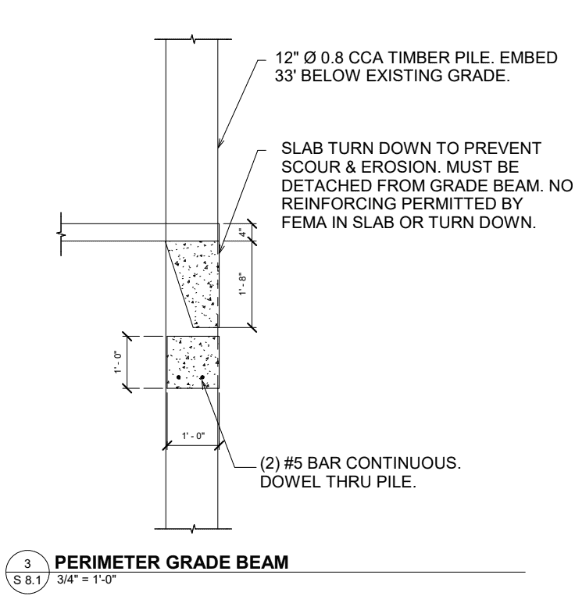
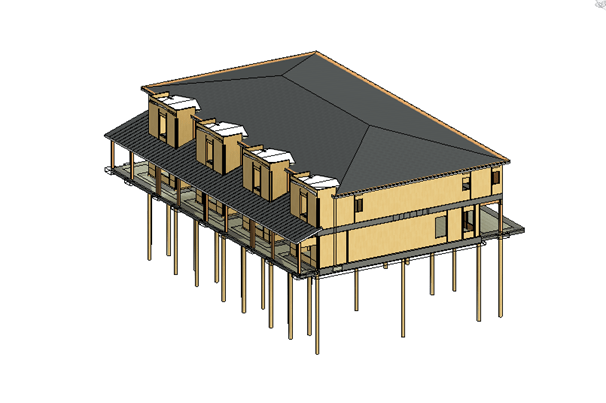
Uppteam was responsible for the structural design and modeling of a Double-story multi-family house located near a water body. The team was responsible for creating documentation for county submission while designing a wooden pile foundation for the building.

Project Timeline

  • Week 1: Designing the roof structure and framing finalization and modeling in Revit
  • Week 2: Lateral loads calculations, shear walls design, and lateral loads transfer
  • Week 3: Finalization of floor beams and rafters with detail drawings check and finalizations. Manual calculations determine the maximum loads transferred from the roof to the piles.

Additional Notes

  • Based on the client's requirements for creating longer spans of roof beams in a shallower depth of ceiling, we provided laminated beams and also supported roof rafters with walls on ceiling joists for bigger spans.
  • Shear transfer was also critical as lateral loads were significant in both directions of the structure. So, we sheathed both sides of the shear walls with heavy hold-downs.
  • Since the structure was near a water body, we needed to calculate the load transfer minutely.
  • The structural design, modeling, and construction documents from the Uppteam structural design team closely matched the architecture of the Multi family residence, requiring no further changes, which significantly reduced the overall project cost.

Engineering Mythbusters: Structural Design Myths You Should Stop Believing

  • Soumen
  • June 18, 2025
  • 9:54 am

Walk into any AEC office, and you will hear the same “truths” repeated project after project. “Make the slab denser—it is safer.” “Proportional structures are always more stable.” “BIM will notice everything.” Sound acquainted?

These speculations have been passed down through the ages of engineers and architects, much like family recipes—except that a few of these formulas are obsolete, costly, and occasionally destructive. The built conditions deserve better than layout decisions based on yesterday’s constraints.

Today’s structural engineers have powerful tools that were unthinkable just twenty years ago. Parametric modeling, AI-assisted design, and coordinated Building Information Modeling (BIM) platforms have transformed what is possible in design. Yet numerous teams still default to the same old rules of thumb.

Design support specialists help companies in the AEC (Architecture, Engineering, and Construction) sector break free from old thinking. Firms like Uppteam bring new ideas and careful analysis to projects that might otherwise just repeat familiar patterns.

The Myths That Need to Perish

Myth #1: Thicker Slabs Always Mean Better Structural Integrity

Let us start with, perhaps, the most expensive myth in structural design.

Here is what happens: 

Slab viscosity is just one variable in a complicated equation. What are the fundamental drivers of structural performance? Load distribution, reinforcement strategy, material properties, and span geometry. Automatically defaulting to dense slabs is like purchasing the most expensive car, believing it is the fastest—you are probably just paying for features you do not need.

A 12-inch slab carrying the same loads as an optimized 8-inch slab with strategic reinforcement. The thicker slab costs more in materials, creates unnecessary self-weight (often requiring beefier foundations), and steals precious ceiling height that MEP engineers desperately need.

The real-world impact hits three ways:

  • Budget pain: Material costs spike and that extra concrete adds embodied carbon that sustainability consultants will flag
  • Coordination chaos: MEP teams suddenly find themselves fighting for vertical space, leading to coordination conflicts that ripple through the entire project
  • Redesign nightmares: When floor-to-floor heights don’t work, someone’s going back to the drawing board—and it is expensive

Modern structural analysis tools can optimize slab thickness down to the square foot. Why guess when you can calculate?

What to do instead:

  • Run your loads through FEM analysis before picking the thickness
  • Test multiple reinforcement strategies parametrically
  • Get MEP input early—they’ll thank you later

Myth #2: All Buildings Should Be Symmetrical for Stability

This one drives architects crazy, and for good reason.

Symmetry certainly makes structural analysis easier—no argument there. However, simpler does not always equate to superior, and it certainly does not imply it’s essential. Numerous renowned structures in the world abandon symmetry yet still maintain complete stability.

Take Beijing’s closed-circuit television headquarters. That crooked, interconnected form appears to defy physics, yet it is engineered to withstand everything from wind loads to seismic activity. How? Advanced modeling, strategic mass distribution, and careful load path design.

The hidden costs of symmetry obsession:

  • Creative limitations: Architects get boxed into forms that may not serve the building’s actual function
  • Market disadvantage: Distinctive, asymmetrical buildings often command premium rents and sales prices
  • Missed opportunities: Sometimes, the most efficient structural solution is inherently asymmetrical

Here’s the thing about modern structural software—it doesn’t care if your building looks like a crystal or a cube. It calculates loads, analyzes deflections, and optimizes member sizes based on physics, not aesthetics.

The smart approach:

  • Use advanced load modeling to understand how forces move through asymmetrical forms
  • Consider tuned mass dampers or strategic bracing for complex geometries
  • Run dynamic analysis early, not as an afterthought

Myth #3: Concrete Structures Do Not Require Flexibility in Design

This misinterpretation has probably provoked more long-term concerns than any other on this list.

Concrete’s compressive resilience is legendary—it is why we have been building with it for over a century. At the same time, that same strength becomes a weakness when concrete cannot accommodate movement. Seismic activity, thermal expansion, and accommodation—all of these create pressure that rigid concrete structures handle poorly.

The result? Cracks, spalling, and supervision problems can affect a building for many years. For example, one major hospital project exhibited severe cracking within five years because the original design team believed that concrete could withstand thermal movement without the use of special expansion joints.

Where inflexibility hurts most:

  • Seismic zones: Inflexible concrete constructions can fail catastrophically during earthquakes
  • Future adaptability: Retrofitting inflexible structures for new loads or systems is often impossible
  • Large spans: Thermal expansion becomes a significant factor in buildings over 200 feet long

The modern concrete design embraces flexibility through strategic detailing. Post-tensioning systems, fiber reinforcement, and base isolation—these are no longer exotic technologies. They are standard tools for creating concrete structures that can adapt and endure.

Practical flexibility strategies:

  • Plan expansion joints every 200-300 feet in large structures
  • Specify fiber-reinforced concrete for high-stress applications
  • Consider base isolation in seismic regions

Myth #4: BIM Automatically Fixes All Design Errors

BIM has revolutionized the AEC industry, but it is not magic.

The promise of BIM—better coordination, fewer conflicts, streamlined workflows—is real. However, somewhere along the way, many teams began treating BIM software as an omniscient design assistant that would catch every mistake and optimize every decision.

That is not how it works. BIM is mighty for visualization, coordination, and documentation. It can flag when a beam conflicts with a duct or when door schedules don’t match floor plans. However, it cannot verify whether your load assumptions are accurate or whether your connection details will function adequately in the field.

One mid-rise commercial project learned this lesson the hard way. Their BIM model looked perfect—no clashes, beautiful renderings, and coordinated systems. However, because nobody questioned the structural assumptions embedded in the model, they ended up with undersized beams that required reinforcement during construction.

Where BIM falls short:

  • Engineering judgment: Software cannot replace a fundamental understanding of structural behavior
  • Code compliance: Automated checks catch evident violations but miss nuanced requirements
  • Constructability: A model might coordinate perfectly, but be impossible to build efficiently

Less BIM is not the reply—smarter BIM is:

  • Establish clear validation protocols that combine automated checks with human oversight
  • Regular design reviews that question assumptions, not just coordination
  • Quality control processes that verify both virtual and physical feasibility

Myth #5: Prefabricated Components Don’t Allow Design Flexibility

This myth costs the industry millions in lost efficiency every year.

The old image of prefabrication—rigid, standardized components that force compromise—hasn’t been accurate for at least a decade. Today’s prefab systems use parametric design tools and digital fabrication techniques that can accommodate significant customization while maintaining the speed and quality advantages of factory production.

A recent stadium project demonstrates this perfectly. The design team needed complex roof trusses with varying geometries to match the architectural form. Instead of defaulting to stick-built construction, they worked with a prefab manufacturer to create parametrically designed modules. Each truss was unique, but all were manufactured to precise tolerances in controlled conditions.

The result? Thirty percent faster installation, better quality control, and the ability to make minor field adjustments when needed.

Why teams avoid prefab (and why they shouldn’t):

  • Flexibility fears: Modern prefab systems can accommodate significant variation
  • Quality concerns: Factory conditions typically produce better results than field construction
  • Integration challenges: Early coordination with prefab suppliers solves most issues

Making prefab work:

  • Engage prefab suppliers during design development, not after
  • Use parametric tools to balance standardization with customization
  • Plan for modular coordination from the beginning

Real Projects, Real Lessons

When Thick Slabs Backfire

A combined-use project in Seattle serves as an ideal example of excessive slab design. The structural team, playing it safe, specified uniform 10-inch slabs throughout the building. The logic seemed sound—thick slabs would handle any loading scenario.

But post-occupancy analysis revealed the reality. Most areas were significantly over-designed, resulting in a waste of approximately 12% of the concrete volume. More problematically, the extra thickness created coordination issues with the HVAC system, forcing ductwork into smaller spaces and creating pressure drop issues that increased energy costs.

A subsequent parametric analysis revealed that a variable slab thickness—ranging from 8 to 10 inches, based on actual loads—would have saved money and improved building performance.

Asymmetry Done Right

An architecture firm designing a high-end residential tower faced pushback from consultants who wanted to “regularize” the building’s distinctive twisted form. The architects pushed back, working with structural specialists to model the complex load paths created by the asymmetrical geometry.

The solution involved offset structural cores, strategic mass distribution, and carefully tuned bracing systems. The result was a building that met all performance criteria while maintaining its architectural integrity. Bonus: The unique shape warranted a higher price that more than compensated for the extra engineering work.

Prefab Success Story

A sports arena project initially planned for conventional steel construction changed course when the team discovered that prefabricated roof trusses could be parametrically designed and manufactured off-site. Despite initial concerns about flexibility, the system allowed for significant customization while reducing construction time by 30%.

Each truss was unique, manufactured to precise tolerances, and designed for efficient installation and assembly. Minor field adjustments were possible but rarely necessary due to the accuracy of the prefab process.

The Technology that is Changing Everything

AI Gets Real About Design

AI (artificial intelligence) has moved beyond the hype phase in structural design. Today’s AI tools can analyze thousands of design iterations, identify patterns in structural failures, and flag potential issues that might escape human attention.

However, here’s what AI does best—it handles the tedious analysis that allows engineers to focus on creative problem-solving. Instead of spending hours manually checking load paths, engineers can explore more design alternatives and optimize performance across multiple criteria simultaneously.

Parametric Design Unleashed

Parametric modeling has democratized design optimization. What once required specialized software and extensive training can now be done by any engineer comfortable with standard design tools.

The power is not just in optimization—it is in exploration. Parametric tools enable design teams to test assumptions, explore alternatives, and understand the relationships between various design variables. Want to know how changing beam depth affects deflection, cost, and mechanical coordination? Run the analysis and find out.

Collaboration Without Compromise

Modern collaboration platforms address the ongoing challenge of working together while maintaining creativity. With shared models, real-time updates, and integrated workflows, teams can make structural decisions across different fields without compromising the design intent.

To ensure effective communication and validation of changes, it is essential to establish clear protocols. Technology helps us work together, but it is the human processes that make this collaboration successful.

A Different Way Forward

Stop Defaulting to “Safe”

The most significant barrier to better structural design is not technology—it is culture. Many teams default to conservative assumptions, not because they’re actually safer but because they’re familiar. Thick slabs, symmetrical forms, rigid concrete details—these approaches feel secure because they’re predictable.

However, predictability is not always optimal. Sometimes, the “safe” choice creates new problems or misses opportunities for better performance. Absolute safety comes from understanding the forces at work and designing accordingly.

Embrace Calculated Risks

This doesn’t mean throwing caution to the wind. It means using analysis to understand where conservative assumptions are justified and where they’re wasteful. Modern tools can model complex scenarios with unprecedented accuracy—use that capability.

Partner with Specialists

Not every business needs to evolve into an expert in every facet of cutting-edge structural design. Sometimes, the most visionary approach is partnering with professionals who can bring distinctive expertise to demanding assignments.

Design support firms like Uppteam excel at bridging the crevice between design purpose and structural truth. They obtain analytical rigor, software expertise, and reinvigorated viewpoints that can convert good designs into great ones.

The Bottom Line

Structural design is evolving more rapidly than many firms can keep pace with. The tools we have today would have seemed impossible a generation ago. However, they are only helpful if teams are ready to question old beliefs and try new methods.

The myths we have discussed—dense slabs, proportional buildings, hard-and-fast concrete, BIM as a cure-all, and limited prefab—prevail because they feel safe. However, safe is not always smart, and smart is not always apparent.

The firms that thrive in today’s market will be those that combine unconventional analytical tools with rudimentary engineering judgment. They will question hypotheses, test alternatives, and partner with experts when needed. Most significantly, they will recognize that the best structural design is not about following rules—it is about understanding forces and responding intelligently.

The built environment deserves structures that are not just safe and efficient but optimized for their specific context and purpose. That level of performance requires moving beyond myths and embracing the analytical power available today.

Time to stop repeating old truths and start creating new ones.

The Role of Shop Drawings in Construction: A Comprehensive Guide

  • Soumen
  • March 27, 2025
  • 1:16 pm

Shop drawings are crucial to the construction process. They are detailed technical documents that provide precise information on how various building elements should be fabricated, assembled, and installed.

To develop shop drawings from point cloud data for Building Information Modeling, designers begin by capturing the existing structure using a laser scanner. Some companies partner with point cloud BIM services providers with in-house experts to read the cloud data and convert it into BIM models, which are 3D construction models. The details of the drawings depend on the client’s requirements.

Unlike architectural drawings, which emphasize overall design and aesthetics, shop drawings focus on specific construction details, ensuring that every element fits seamlessly into the broader project.

Whether constructing a high-rise tower or a small residential building, shop drawings serve as the roadmap for contractors, engineers, fabricators, and installers. These drawings bridge the gap between design and practical execution, ensuring that the final structure aligns with the original vision while maintaining structural integrity and compliance with industry standards.

Purpose and Importance of Shop Drawings

Shop drawings play a crucial role in construction by:

  • Providing Clarity: They translate design concepts into actionable, practical instructions for fabrication and assembly.
  • Ensuring Accuracy: Precise measurements, materials, and construction details help prevent errors and reduce costly rework.
  • Enhancing Coordination: Top BIM services providers in the USA look for shop drawings, which facilitate seamless collaboration among architects, engineers, contractors, and suppliers.
  • Improving Efficiency: Detailed instructions help streamline production, minimize delays, and optimize resources.
  • Supporting Quality Control: Shop drawings include specifications and compliance details, ensuring that the final construction meets regulatory and contractual requirements.

Shop drawings become indispensable for large-scale complex projects involving custom components. They help maintain consistency across teams and trades, ensuring that each element integrates properly within the overall structure.

Components of Shop Drawings

A well-prepared shop drawing contains the following key elements: appropriate Dimensions—Exact measurements of each component to ensure proper fitting within the project. Every detail, from length, width, and height to tolerances and allowances, must be precisely documented to prevent errors during fabrication and installation. These dimensions ensure that the components integrate seamlessly with other structural elements.

  • Material Specifications—Details on materials, including type, grade, and finish. Material selection is critical to the project’s structural integrity, durability, and aesthetics. Companies often outsource BIM services, as shop drawings projects provide information on material properties such as t, corrosion resistance, fire ratings, and sustainability considerations. This helps ensure that all components comply with industry standards and project requirements.
  • Construction Techniques – Assembly instructions outlining fabrication methods and installation procedures. These instructions provide insights into how components will be manufactured, cut, welded, or assembled. For example, steel shop drawings may specify the type of welding technique required, while millwork drawings may detail joinery methods such as mortise and tenon or dovetail joints.
  • Connections & Joints – Information on how different parts will be attached (e.g., welding, bolting, fastening methods). The effectiveness of these connections directly impacts structural stability and performance. Shop drawings indicate the placement of bolts, screws, anchors, and welds, ensuring that each connection aligns with safety and strength standards.
  • Field Measurements – Site-specific dimensions to account for real-world conditions. Unlike standard design dimensions, field measurements ensure that prefabricated components fit correctly within the construction site’s existing conditions. This is particularly crucial for renovations or retrofitting projects where existing structures may not align perfectly with design drawings.
  • Coordination Details – Building Information Modeling support providers show the interaction points between structural, mechanical, electrical, and plumbing systems. Shop drawings illustrate how various building elements work together, preventing system clashes. For example, they help avoid conflicts where HVAC ducts might interfere with steel beams or plumbing pipes might cross electrical conduits. Coordination details ensure a streamlined construction process with minimal delays and modifications.
  • Finish Details—Surface treatments, coatings, and other finishing specifications. Proper finishing techniques often determine a component’s final appearance and durability. These may include paint, powder coatings, anodization, sealing, or polishing. Specifying the correct finishing details in shop drawings helps achieve the desired aesthetic and functional results while complying with project requirements.
  • Assembly Drawings—These are Step-by-step visual instructions for on-site assembly. They include exploded views, sequencing diagrams, and detailed labels to guide installers in putting together complex components. Assembly drawings are crucial for prefabricated and modular construction elements, where efficiency and accuracy in assembly directly impact project timelines.
  • Compliance Information – Regulatory standards and project specifications for quality assurance. This section ensures that all shop drawings adhere to building codes, safety regulations, and industry best practices. Compliance information may reference ASTM standards, ISO guidelines, or local building regulations. Proper documentation of compliance minimizes risks, ensures legal adherence, and enhances overall project integrity.

Who Creates Shop Drawings?

Top BIM services provider in the USA prepare shop drawings on behalf of:

  • Architects & Engineers – Provide design intent and approve shop drawings for compliance.
  • Drafters & BIM Specialists – Utilize CAD and BIM tools to create detailed drawings.
  • Contractors & Fabricators – Develop shop drawings based on design documents and field conditions.
  • Specialized Consultants – Ensure accuracy in complex projects, particularly for MEP and structural elements.

Creating shop drawings requires collaboration between multiple stakeholders to ensure accuracy, compliance, and the construction Shop Drawing Process.

The process of creating and utilizing shop drawings involves several critical steps, ensuring accuracy, efficiency, and seamless coordination in construction projects:

  1. Reviewing Design Documents—The process begins with a thorough review of architectural and engineering plans. These documents provide the foundation for shop drawings, ensuring a thorough review of the intended design. This step helps identify any missing information or inconsistencies before drafting begins.
  2. Field Measurements & Site Analysis – Before drafting, precise measurements are taken from the site to account for real-world conditions. These measurements help detect any discrepancies between the design intent and actual site constraints, ensuring that prefabricated elements fit correctly during installation.
  3. Drafting & Detailing – Using advanced CAD and BIM software, outsource BIM services providers to create shop drawings meticulously. These drawings—Outsource BIM services providers meticulously create shop drawings, including dimensions and material specifications, allowing for greater accuracy and integration of 3D models, making visualization easier for all stakeholders.
  4. Internal Review & Coordination—Once the shop drawings are drafted, they undergo a rigorous internal review. Coordination among architects, engineers, and different trade teams ensures that structural, mechanical, electrical, and plumbing (MEP) elements do not clash. Clash detection within BIM tools helps preemptively resolve potential conflicts before construction begins.
  5. Submission for Approval – The reviewed shop drawings are then submitted to project managers, engineers, and architects for approval. This step ensures compliance with design intent, regulatory requirements, and industry standards. Any required modifications or clarifications are addressed before final approval is granted.
  6. Fabrication & Assembly—Once approved, shop drawings serve as a guide for manufacturers, fabricators, and construction teams. Fabrication teams use the drawings to manufacture the specified guides, while on-site construction teams follow the assembly instructions for accurate installation.
  7. Ongoing Revisions & Updates – During construction, adjustments may be needed due to unforeseen site conditions or last-minute design changes. Revised shop drawings help accommodate these changes while maintaining overall project integrity. Real-time updates through cloud-based collaboration tools ensure that all teams work with the latest version of the drawings.

Types of Shop Drawings

Point cloud to BIM services providers categorize shop drawings into several types based on the project’s requirements:

1. Architectural Shop Drawings

  • Focus on design elements like doors, windows, cabinetry, and custom finishes.
  • Include detailed instructions for material selection and aesthetic considerations.

2. Structural Shop Drawings

  • Provide specifications for load-bearing components like steel framing, concrete reinforcements, and structural connections.
  • Ensure compliance with engineering calculations and building codes.

3. MEP Shop Drawings

  • Detail HVAC systems, electrical wiring, and plumbing layouts.
  • Essential for coordinating between different trades and preventing clashes on-site.

4. Specialized Shop Drawings

  • Cover unique or custom elements like curtain walls, modular assemblies, and prefabricated components.
  • Require additional precision due to customization and integration with other building systems.

Common Mistakes in Shop Drawings

Additional drawings are required to lead to significant project delays and cost overruns. Some of the most recurring errors include:

  • Missing or Incorrect Dimensions – Leads to fabrication errors and misalignment during installation.
  • Material Specification Errors – Using the wrong materials can compromise structural integrity and aesthetic appeal.
  • Poor Coordination Between Trades – MEP conflicts with structural components often cause costly revisions.
  • Incorrect Connection Details – Bolt hole misalignments, incorrect welding specifications, and fastening issues can result in major on-site problems.
  • Failure to Update Revisions – Outdated drawings can cause inconsistencies in execution.
  • Scaling Issues – Incorrect scaling can lead to the fabrication of oversized or undersized components.

Thorough review, cross-checking with design documents, and using advanced tools help minimize these errors.

How Technology is Transforming Shop Drawings

Advancements in digital tools have significantly improved the accuracy and efficiency of shop drawing creation. Key technological innovations include:

1. Building Information Modeling (BIM)

  • 3D modeling enhances coordination and reduces clashes between building systems.
  • Enables real-time collaboration among project teams.

2. Automated Drafting Software

  • CAD and BIM platforms like AutoCAD, Revit, and Tekla Structures streamline the drafting process.
  • Reduce human errors by generating precise dimensions automatically.

3. Cloud-Based Collaboration

  • Enables remote teams to review and update shop drawings in real time.
  • Ensures that all stakeholders have access to the latest revisions.

4. Augmented & Virtual Reality

  • AR/VR applicational time visualizes construction components in real-world environments before installation.
  • Improves accuracy and on-site execution.

5. Digital Fabrication & CNC Integration

  • Direct integration with CNC machines and 3D printers allows for automated manufacturing.
  • Enhances precision and efficiency in component fabrication.

Conclusion

Shop drawings are a cornerstone of modern construction, transforming abstract designs into precise, actionable plans. By providing detailed guidance for fabrication and installation, they enhance coordination, improve accuracy, and reduce project risks. Uppteam, as a leading point cloud to BIM services provider, specializes in delivering high-quality shop drawings that integrate seamlessly with client workflows, ensuring precision and efficiency at every stage of the project.

With advanced BIM technology, automation, and a team of skilled BIM designers, Uppteam streamlines the project stages, minimizing errors and optimizing project timelines. As construction projects grow in complexity, the need for detailed, well-coordinated shop drawings becomes even more critical. Uppteam’s expertise becomes complex, accurate, and compliant documentation, making the execution of construction projects smoother and more cost-effective.

Structural Design Support Services

  • Soumen
  • September 29, 2024
  • 12:46 pm

Our Structural Support Services can enhance your structural engineering projects with expert support. From conceptual design to detailed drawings, our experienced team provides end-to-end structural solutions across commercial, multi-family, industrial, retail, and residential projects. Learn how we can support your firm’s productivity with high-quality, fast turnarounds and exceptional attention to detail. Download the brochure to explore how we can bring your next project to life!

Download Now

A Multifamily Project with Unique Structural Challenges in New York

  • arnab
  • September 28, 2024
  • 8:39 pm

Intro

Uppteam recently completed a multifamily residential project with unique structural challenges. Find out how, despite the complexities, the team successfully delivered the project, saving the client 10 days on their tight deadline.

Project Type: Multifamily Residence

Software Used: Autodesk AutoCAD, Trimble Tekla Tedds, and Microsoft Excel

Task Assigned

Based on the sketch the client shared, they wanted us to create load calculations and beam and column design.

Challenges

The most pressing challenge faced by Uppteam was the limited timeframe allotted for the 20,000 sq. ft. project. We had to complete it in very few days, which put significant pressure on the design team to complete the structural calculations and drawings efficiently.

A vital issue arose during the initial header calculations. Some of the headers were found to carry point loads from the roof, which can be more challenging to design and analyze than uniformly distributed loads.

These point loads required careful consideration to ensure the header’s structural integrity and prevent excessive deflection.

Solutions

We approached the project with a streamlined design process, focusing on efficient communication, collaboration, and utilization of advanced software tools to minimize delays and ensure timely completion. Uppteam successfully addressed these challenges through meticulous analysis and design, providing the client with a comprehensive foundation and framing design.

We did rigorous structural analyses to accurately determine the required header sizes and spacing, ensuring that they could safely support the loads from the roof.

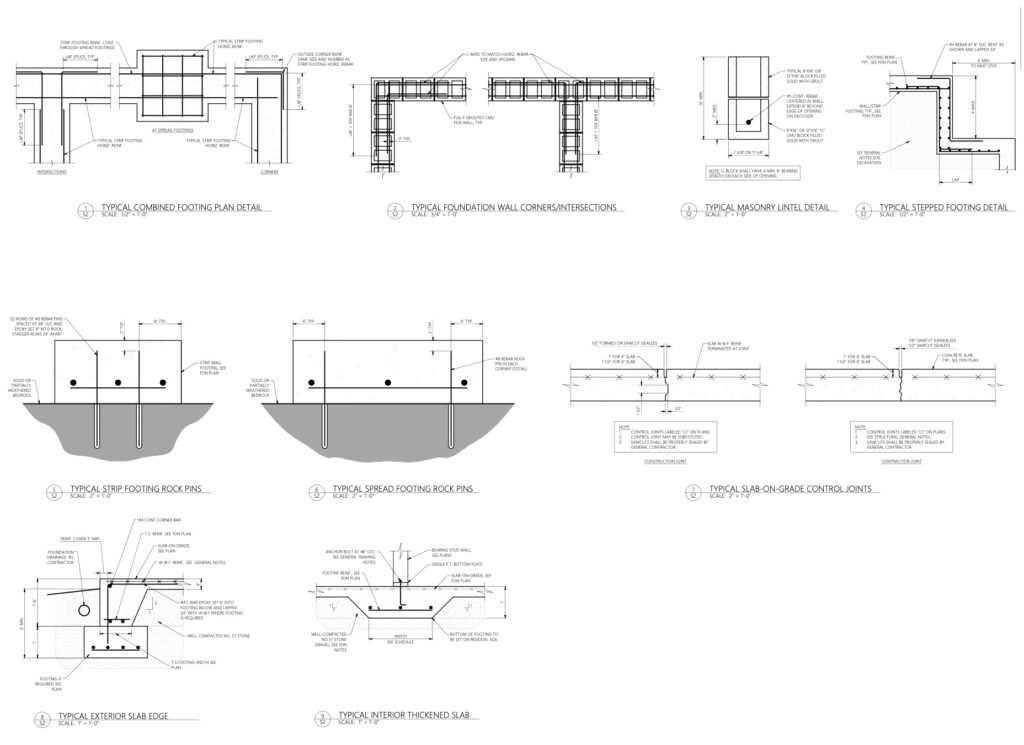
Using BIM tools, we created detailed drawings and schedules for concrete wall foundations and wooden walls with wooden roofs. Based on the client’s feedback, our team members iterated on the design to ensure flawless final deliverables. Our structural design support team provided the client with a detailed design of the gravity and structural load effects system. With this approach, we completed the project in 5 days. 

Multi-level Structural Design for A Residential Framing in North Carolina

  • arnab
  • September 28, 2024
  • 8:33 pm

Intro

Residential framing is an essential component in a construction design project. Let’s understand how we achieved the design needs in this project.

Project Type: Residential

Software Used: AutoCAD

Task Assigned

The client needed support regarding the use of hangers, connectors, and screws to secure framing members. These joints and connections are vital in ensuring the structural integrity of the building.

Challenges

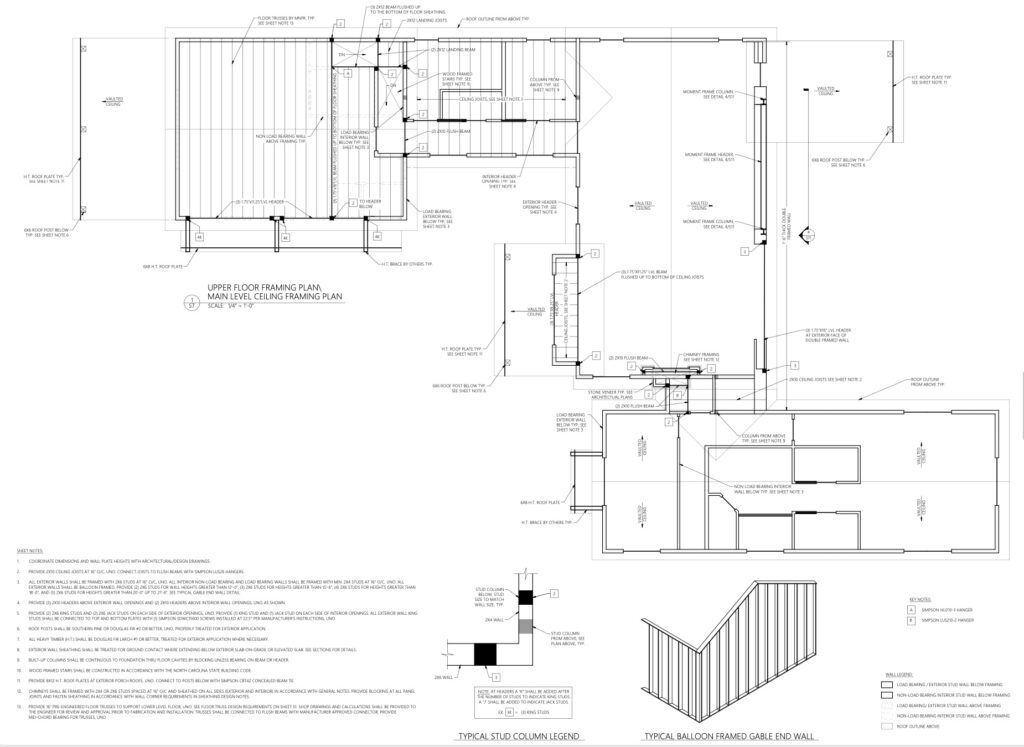
The structural design project was incredibly challenging for Uppteam’s structural designers because of its multi-level drawing requirements. The multiple levels can make the drawing appear cluttered and difficult to understand.

It was difficult to grasp how the levels connect and interact and to convey the purpose and function of each level clearly and concisely. Completing this project delivery in a week was a great challenge.

Solutions

Our structural designers created multi-layered designs to solve the visual complexity, making simplified diagrams. We also incorporated architectural input and generated a complete structural working drawing set simultaneously to meet deadlines.

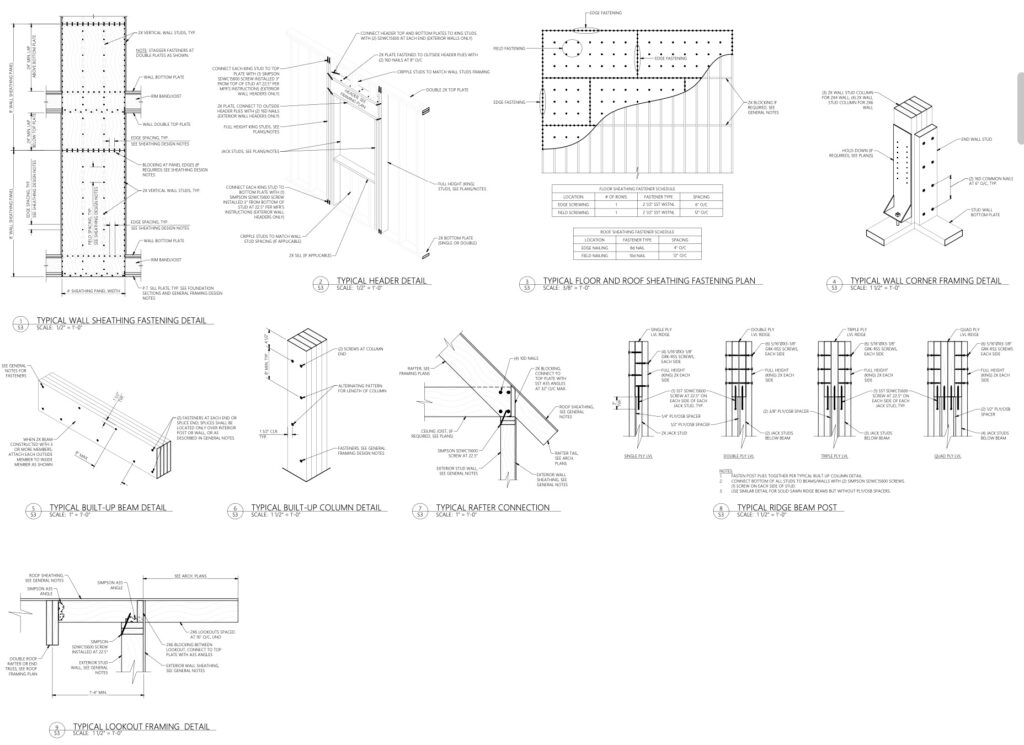
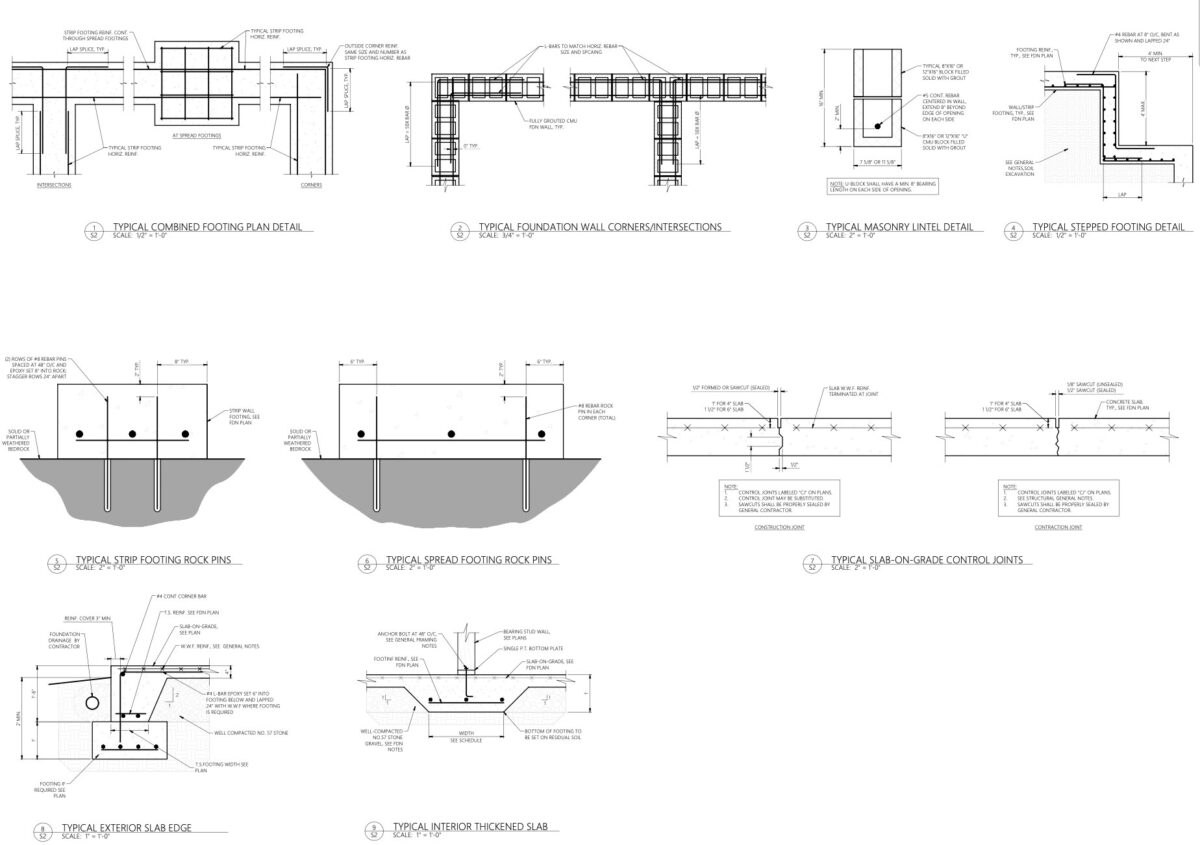
Additionally, we used annotations and cross-sections to indicate the relationship between various levels and connections among structures. The labeled diagram our structural design team created with its specific purpose helped the client with concise explanations. Uppteam’s structural designers’ high-quality presentation was based on the CMU Wall Foundation and wooden walls with wooden roofs.

The design creates a comprehensive guide outlining the necessary elements, materials, and techniques to create a sturdy and durable framework for a home.

We explored various lumber sizes, such as 2x4s, 2x6s, and 2x10s, for framing walls, ceilings, and floors. These structural components form the backbone of the building, providing the necessary support for the entire structure. Besides, we focused on framing techniques such as balloon and platform framing, leveraging their advantages.

With these meticulous efforts, we could close this project of +30000 sq feet in less than a week.