3rd Party QC
Why RFIs Keep Multiplying and What You Can Do About It
-
 Soumen
 - September 1, 2025
- 11:55 am


U.S.-based local architectural representation, ensuring communication, accountability, and delivery expectations, managed close to the client.
Explore more
Discover our architectural design excellence through a curated selection of projects.
Explore more
Take a look at how Uppteam can elevate your projects with expert engineering solutions.
Explore more
Our Structural Support Services can enhance your structural engineering projects with expert support.
Explore more
Uppteam delivers precise and reliable surveying and mapping solutions to help you make informed decisions.
Explore more
Whether you're working on residential, commercial, or industrial buildings..
Explore more
Uppteam’s Virtual Admin Support can help you with all your administrative tasks..
Explore more
Our experts work as your Second Eye Services expert.
Explore more Soumen
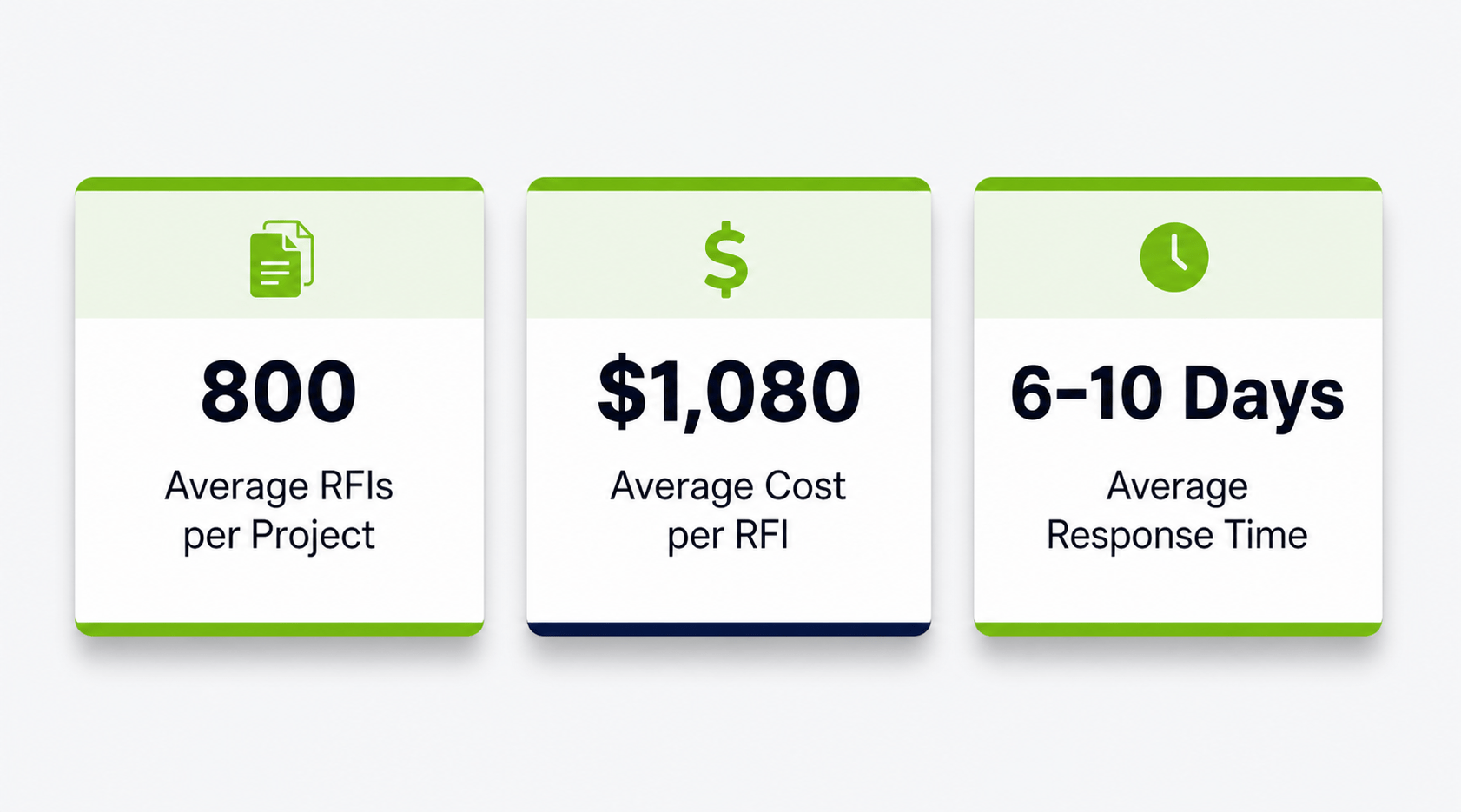
What causes the average construction project to generate around 800 RFIs, while some projects exceed 5,000? You’re probably wondering how these specific figures come about. In 2013, Chicago’s Navigant Consulting conducted an extensive study on the impact of RFIs in construction. A staggering 1,352 global projects were reviewed to perform the analysis. The figures mentioned above reflect the astonishing outcomes of that study.
By now, the widespread prevalence of information requests in construction projects is clear. RFI documents are among the most expensive communication challenges in the construction industry.
Industry insights reveal that up to 86% of project expenses are allocated to addressing inefficiencies in RFI workflows rather than actual construction work.
The Navigant study also indicated that dealing with a single RFI costs construction businesses an average of $1,080 per request. Response times typically range from 6 to 10 days, depending on the project’s complexity and location. This pattern points to deeper, systemic problems, ones that can be anticipated and managed.
Understanding why RFIs multiply gives AEC companies a clear path to action, cutting costly delays, improving communication, and keeping projects on track. The financial impact encompasses not only response costs but also project delays and rework expenses.
Inadequate construction documents are the main driver of extensive RFI generation. Compressed design schedules rarely leave enough time for thorough documentation review, which is how unclear specifications and fragmented construction details end up in the field.
Poor coordination among architectural, structural, and MEP teams compounds the problem. When these disciplines work in silos, conflicting information inevitably surfaces during construction, and each conflict triggers a new RFI. Value engineering proposals from contractors also result in additional RFIs when the original requirements demand modification.
Site conditions regularly differ from design assumptions, making clarification requests unavoidable and often necessary to prevent costly construction errors. Owner-requested changes multiply RFIs since teams need guidance for every adjustment.
Contractor behavior is another driver. Some contractors deliberately submit excessive RFIs to build paper trails supporting future change order claims, a well-documented practice that floods design teams with requests and slows response times for everyone. This process is overwhelming for design professionals, who are bombarded with numerous requests, leading to delayed responses.
On average, a construction project generates about 9.9 RFIs for every $1 million spent. Smaller-scale projects deal with considerably higher ratios than high-capacity developments. Projects worth $5–50 million generate around 17.2 RFIs for every $1 million spent.

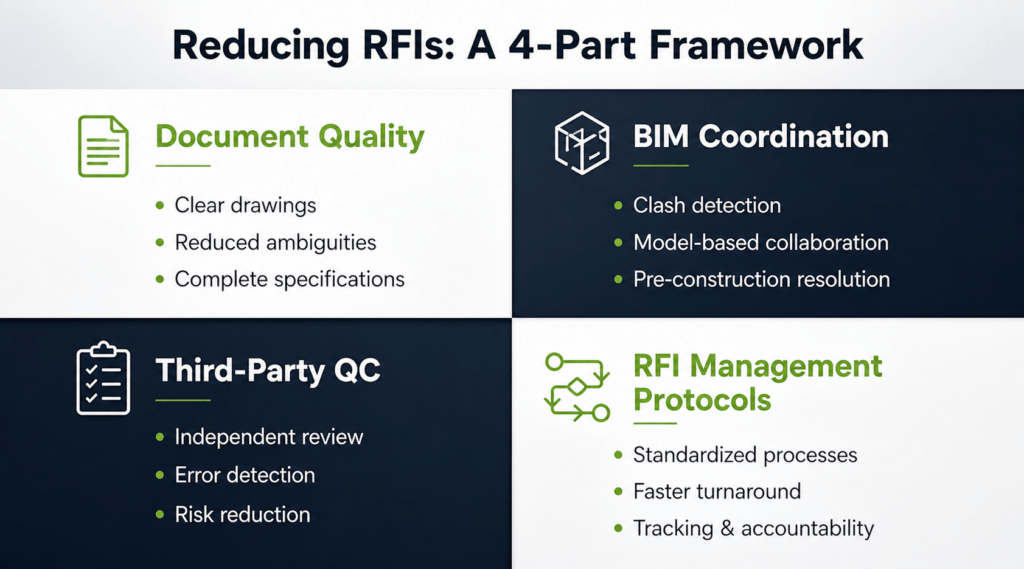
Document quality and RFI volume are directly related: better documents mean fewer requests. The best part of having a robust document review process is spotting potential ambiguities ahead of construction. This effectively removes the need for expensive on-site clarifications.
Setting up clear RFI procedures can help define valid requests. These processes also set forth documentation requirements. In-depth document review by certified experts drastically curtails downstream RFI generation.
To facilitate live coordination between design verticals, digital collaboration tools should be utilized. They encourage conflict resolution before finalizing documentation. Remember that standardized documentation formats enhance clarity and reduce variations in interpretation among project stakeholders.
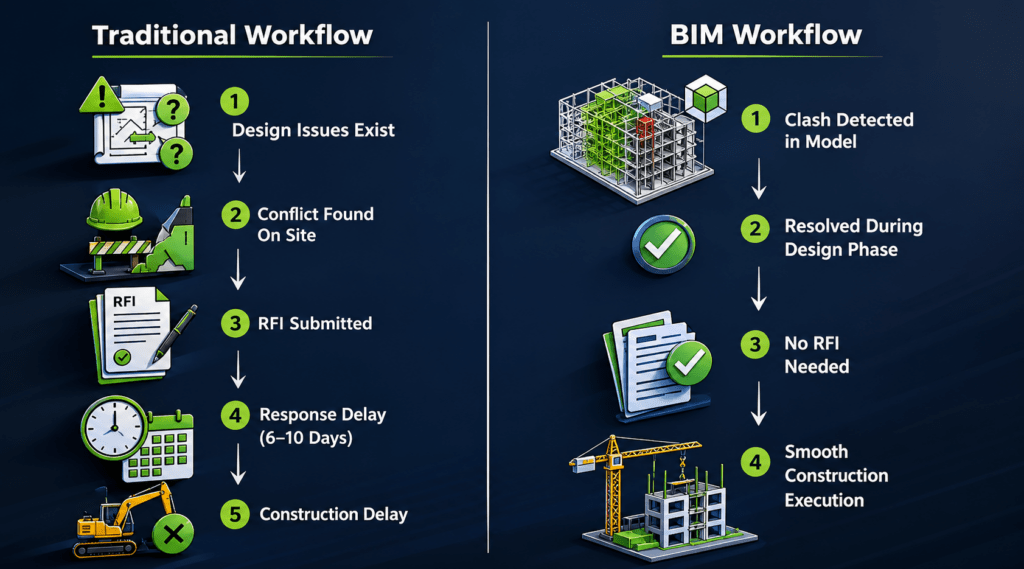
BIM’s most direct impact on RFI volume is clash detection. By identifying conflicts between structural, architectural, and MEP systems before construction begins, teams resolve issues in the model rather than through formal requests on site. The result: fewer interruptions, fewer delays, and a cleaner paper trail when RFIs do occur.
BIM-based RFI management systems go further by centralizing communication across all stakeholders and providing visual context for construction questions, making it easier to respond accurately and quickly. When design intent can be clarified in real time through shared models, many questions never need to become formal RFIs.
Analytics built into modern BIM platforms add another layer of value. By tracking RFI patterns across past projects, these tools can flag where conflicts are most likely to emerge in a current design, allowing teams to address problem areas proactively during documentation rather than reactively during construction.
Cloud-based project delivery platforms reinforce all of this by ensuring every team member works from current information. A significant portion of RFI stems from outdated drawings or version confusion, problems that cloud access largely eliminates.
Four practices, applied consistently, prevent the majority of avoidable RFIs:
3rd-party QC services bring an independent perspective on document quality. These service offerings provide an impartial assessment of potential RFI sources and suggest preventive initiatives. Expert-level quality auditing identifies documentation anomalies before they can affect construction schedules.
Clear communication protocols are foundational. Many requests that become formal RFIs could have been resolved informally with the right channels in place. Additionally, regular coordination meetings should be held between stakeholders. The purpose is to resolve likely issues before they require formal documentation. Lastly, having appropriate training programs in place helps the project team improve RFI quality when requests arise.
When RFIs do occur, these four methods keep them from derailing the project:
Keep in mind that efficient RFI management starts with creating clear submission and response procedures. Establishing time limits for designer responses sustains project momentum. This removes the accumulation of delays.
Standardized RFI formats elevate clarity and simplify review processes. Hence, prioritizing schedule-impact-based RFIs ensures that critical requests receive immediate attention. Moreover, including photographic documentation with RFIs helps alleviate confusion regarding specific conditions. Digital RFI management tools include centralized monitoring and automated workflows. Ultimately, these systems maintain comprehensive project records while enabling real-time status monitoring.
RFI multiplication poses a significant challenge, affecting construction project efficiency, costs, and stakeholder relationships. The main drivers are poor document quality, inadequate coordination across design verticals, and reactive project management. Research indicates that systematic quality control approaches significantly reduce RFI volumes and enhance project outputs.
Independent quality assurance services bring an independent eye to document completeness and likely sources of conflict, shifting the posture from reactive firefighting to prevention. BIM platforms further strengthen this, detecting clashes early and keeping all stakeholders aligned. Together, they address RFI generation at the root rather than at the symptom.
uppteam’s independent QC services are built to catch RFI sources before they reach the field. Acting as a second set of eyes on your documentation, uppteam helps project teams shift from reactive clarification to proactive quality management, protecting timelines and reducing the cost burden that RFIs place on every stakeholder. If your projects are carrying more RFIs than they should, let’s talk.