Architectural Services
How Architect-Led Revit Coordination Streamlines BIM Workflows for AEC Firms
-
 Sreela Biswas
 - October 7, 2025
- 12:16 pm


U.S.-based local architectural representation, ensuring communication, accountability, and delivery expectations, managed close to the client.
Explore more
Discover our architectural design excellence through a curated selection of projects.
Explore more
Take a look at how Uppteam can elevate your projects with expert engineering solutions.
Explore more
Our Structural Support Services can enhance your structural engineering projects with expert support.
Explore more
Uppteam delivers precise and reliable surveying and mapping solutions to help you make informed decisions.
Explore more
Whether you're working on residential, commercial, or industrial buildings..
Explore more
Uppteam’s Virtual Admin Support can help you with all your administrative tasks..
Explore more
Our experts work as your Second Eye Services expert.
Explore more Sreela Biswas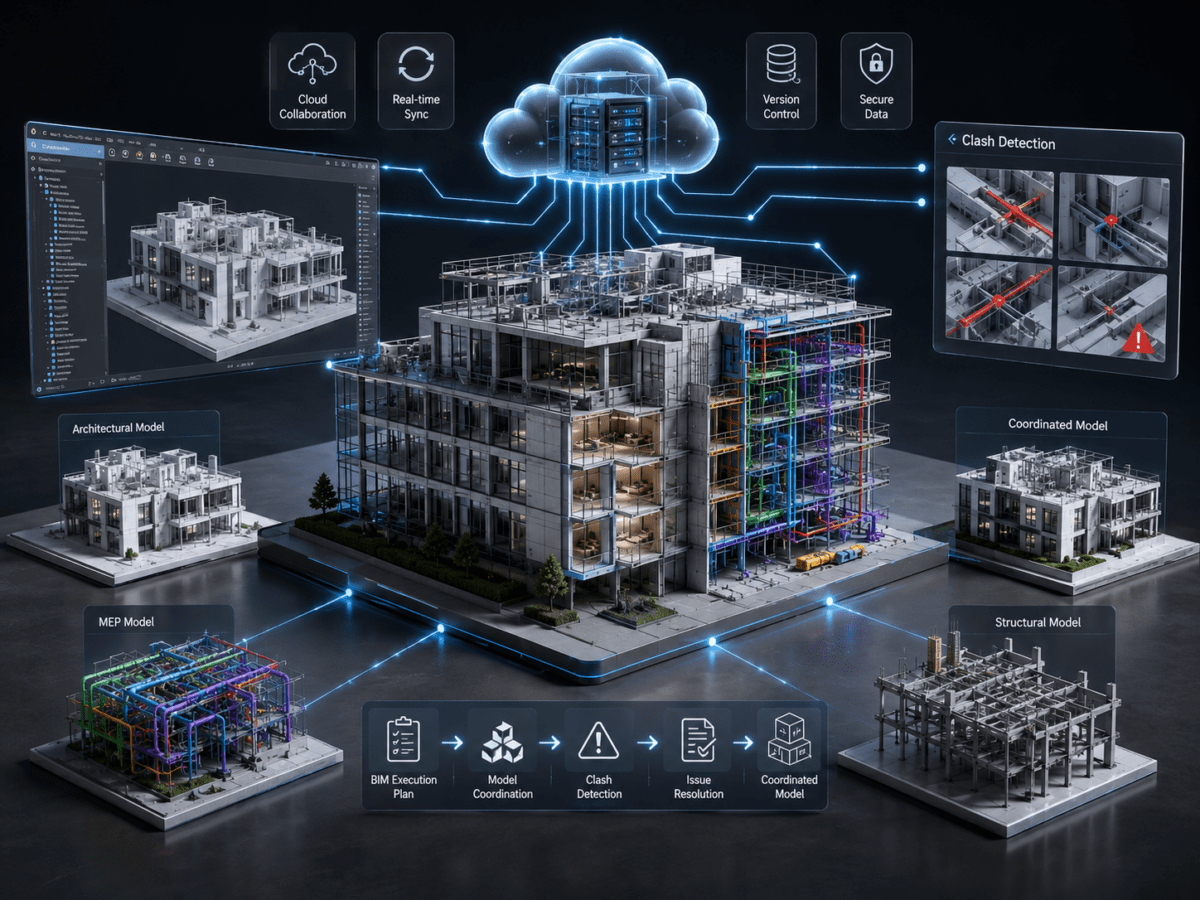
In multidisciplinary AEC projects, coordination gaps among MEP, architectural, and structural systems persist as major contributors to on-site rework, RFIs, and schedule overruns. When architects lead Revit coordination, as opposed to functioning as passive model contributors, BIM operations gain a central authority accountable for clash resolution, model integrity, and cross-disciplinary alignment throughout project phases.
For US-based AEC firms working under strict timelines and competitive fixed-fee contracts, architect-led Revit coordination effectively reduces rework cost exposure, optimizes construction document accuracy, and gives clients the schedule and budget reliability they need. This blog explores how architects can structure that coordination leadership throughout BIM execution planning, model management, cloud collaboration, MEP integration, and clash detection workflows.
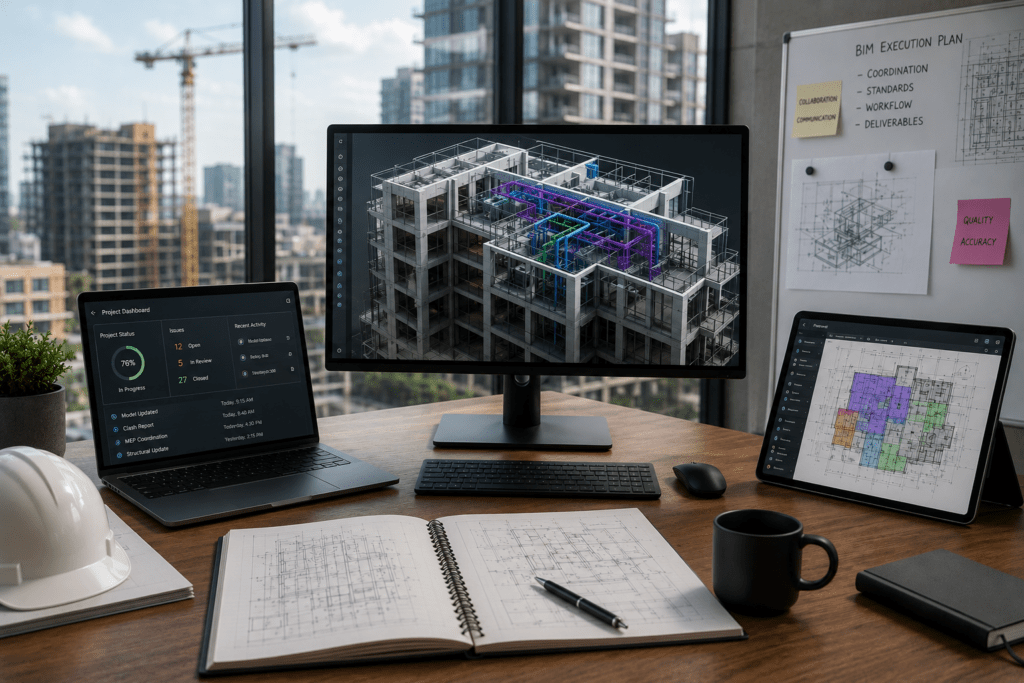
BIM execution plans (BEPs) are the foundation of architect-led coordination. Successful architectural leadership starts with establishing BEPs that define coordination responsibilities, deliverable timeframes, model ownership, and quality control standards. This ensures that architects are the central coordination authority across every project discipline from project commencement.
Clear role definition and oversight of model integration are the two operational anchors of this leadership approach. Architects must allocate particular coordination responsibilities to each project stakeholder, maintain oversight of how discipline models are integrated, and enforce communication criteria that mitigate the coordination gaps that surface when every disciplinary team works in isolation.
Continuous project monitoring and proactive issue resolution are also significant parts of successful coordination leadership. Architects following this approach regularly conduct coordination meetings, track the progress of model development, and confirm alignment between the design intent and construction documentation. Implementation strategies should entail:
Structured model organization is the backbone of successful architect-led coordination. Revit models need clear workset tactics, link management conventions, and file maintenance procedures that support collaborative workflows through every project trade without degrading model performance as project complexity increases.
Regular model maintenance averts performance deterioration and file corruption that disrupt coordination workflows. Monthly audits, purging of unused elements, and centralized file-compacting processes keep models responsive during coordination sessions and curtail the risk of file corruption in high-pressure collaboration environments.
Link management discipline sustains model connections across disciplines, with no performance barriers as file sizes grow. Architects should coordinate ideal linking hierarchies and reference protocols with MEP and structural teams from project setup. In this context, best practices should comprise:
Autodesk Construction Cloud (formerly BIM 360) is the main cloud platform that enables architects to share Revit models in real time and foster team collaboration from a single, centralized environment. Effective operation calls for explicit protocols for data management, access control, and version tracking because, in the absence of such protocols, distributed teams risk working from unsynchronized model states, leading to coordination conflicts.
Technology integration protocols supervise how cloud platforms connect across the project team. Automatic model synchronization schedules guarantee all disciplines access to protocols for field coordination reference, and automated notification systems notify team members when model updates impact their work areas, completing the integration framework.
Another critical factor in architect-led coordination is the development of innovative strategies for integrating MEP and structural systems within Revit environments. Setting clear modeling standards is imperative for successful integration. They demonstrate the role of every discipline in the coordinated model.
Effective MEP and structural alignment mandates that engineers and architects jointly plan system routes, clearances, and installation sequences while specifying coordination zones to eliminate spatial conflicts. Load path management, geometric alignment, and connection detailing ought to be resolved in the model. This helps prevent expensive change orders and schedule disruptions without compromising design integrity or constructability.
Clear MEP routing zone definitions are essential for coordination zone management to prevent conflicts with architectural and structural components, and routine Navisworks clash detection reviews to spot and fix coordination conflicts before fabrication. Moreover, they require coordinated building envelope detailing to ensure that MEP penetrations and structural connections are addressed at the drawing stage, and construction sequencing strategies that support the successful installation of all building systems in the correct order.

Automated clash detection produces results only when coupled with structured resolution workflows. Running Navisworks clash detection reports is the first step in the process. Architects need to review results against construction sequence logic, set resolution priority classifications, delegate responsibility for every conflict category, and verify that proposed solutions are constructible within the project timeline before closing any clashes.
Clear communication protocols, assigned resolution responsibilities, and timely reviews ensure that detected clashes are rectified systematically. Resolution strategies should comprise:
Model-linked communication is the functional core of architect-led coordination. Integrated BIM platforms that connect project correspondence, issue tracking, and meeting records directly to model components give architects the tools to perform reviews, create visual markups, and monitor coordination progress within a shared, traceable environment.
Standardized conventions for information sharing and decision documentation guarantee consistency across distributed teams. Systematic meeting agendas, centralized dashboards for live project visibility, markup tools for resolving design queries, and documentation procedures that embed coordination choices straight into model elements and project phase records establish an auditable coordination trail from start to finish.
When architects lead Revit coordination, it essentially means establishing BIM execution plans, enforcing model standards, handling clash detection operations, and maintaining cross-disciplinary alignment. Consequently, AEC firms can consistently deliver projects with reduced RFI volume, minimal site-level conflicts, and tighter conformance to construction document accuracy standards. The coordination discipline established during design translates directly into lower rework costs, compressed timelines, and better margin performance for both the firm and its clients.
uppteam’s BIM and architectural design teams offer architect-led Revit coordination support for AEC firms across the United States, encompassing BEP, multidisciplinary model management, MEP and structural coordination, and Navisworks clash detection workflows.
Schedule a detailed consultation session with the uppteam to discuss how we can support your firm’s upcoming project coordination requirements.