BIM Services
Earthquake-Resistant Construction: BIM Improves Seismic-Resistant Design
-
 Soumen
 - May 2, 2025
- 5:09 am


U.S.-based local architectural representation, ensuring communication, accountability, and delivery expectations, managed close to the client.
Explore more
Discover our architectural design excellence through a curated selection of projects.
Explore more
Take a look at how Uppteam can elevate your projects with expert engineering solutions.
Explore more
Our Structural Support Services can enhance your structural engineering projects with expert support.
Explore more
Uppteam delivers precise and reliable surveying and mapping solutions to help you make informed decisions.
Explore more
Whether you're working on residential, commercial, or industrial buildings..
Explore more
Uppteam’s Virtual Admin Support can help you with all your administrative tasks..
Explore more
Our experts work as your Second Eye Services expert.
Explore more Soumen
An earthquake is a sudden shaking or trembling of the Earth’s surface that occurs due to the movement of tectonic plates or volcanic activity, which releases energy. Building earthquake-resistant structures is a top priority for engineers, architects, and communities in areas where earthquakes are common. While it is difficult, it is essential for everyone’s safety.
The ever-present threat of earthquakes demands resistant and safe solutions in building earthquake-proof designs. Despite the challenges, Building Information Modeling (BIM), with its digital tools and collaborative approach, empowers engineers and architects to create structures capable of withstanding the forces of nature.
This article examines the relationship between seismic-resistant design principles and BIM, and how digital modeling, structural analysis, and collaborative workflows can enable engineers and architects to build safer infrastructure in high-seismic regions.
An earthquake-resistant building is built to withstand ground movement, strong shaking, and sideways forces. While eliminating seismic risk is impossible, structural design can notably decrease the damage earthquakes cause. Even well-engineered structures may sustain some damage under severe seismic loading. The design objective should be to prevent collapse, protect occupants, and sustain structural integrity through a seismic event.
The buildings need to be specially designed to:
Lessen Structural Damage: The structure must uphold its integrity under seismic loading to evade collapse and safeguard occupants.
Maintain Functionality: The building should remain operational following a seismic event, curtailing downtime and supporting recovery.
Ensure Life Safety: The primary design objective is to protect occupants’ lives at the time of and immediately after a seismic event.
Enable Post-Earthquake Recovery: Design should facilitate expedited structural assessment and reoccupation following a seismic event.
Seismic events generate rapid ground movement and lateral forces. A flexible building can easily sway in this situation instead of resisting its rigidity. This flexibility allows for absorbing seismic energy, reducing structural stress. Methods like base isolation systems or adding flexible joints to the frame can improve structural flexibility.
An earthquake can cause a building to vibrate after the shaking initially stops. The damping mechanism, therefore, helps dissipate this vibrational energy and prevent progressive structural damage. Specimens of damping procedures include friction pendulum bearings or tuned mass dampers, which use enormous weights strategically placed to counteract building oscillation.
With flexibility, it is crucial for the construction to be robust enough to resist the pressures without damage. This means using robust materials like steel and strengthened concrete and designing reinforced structural components. The structural components, like columns and shear walls, spread the tremor forces throughout the construction.
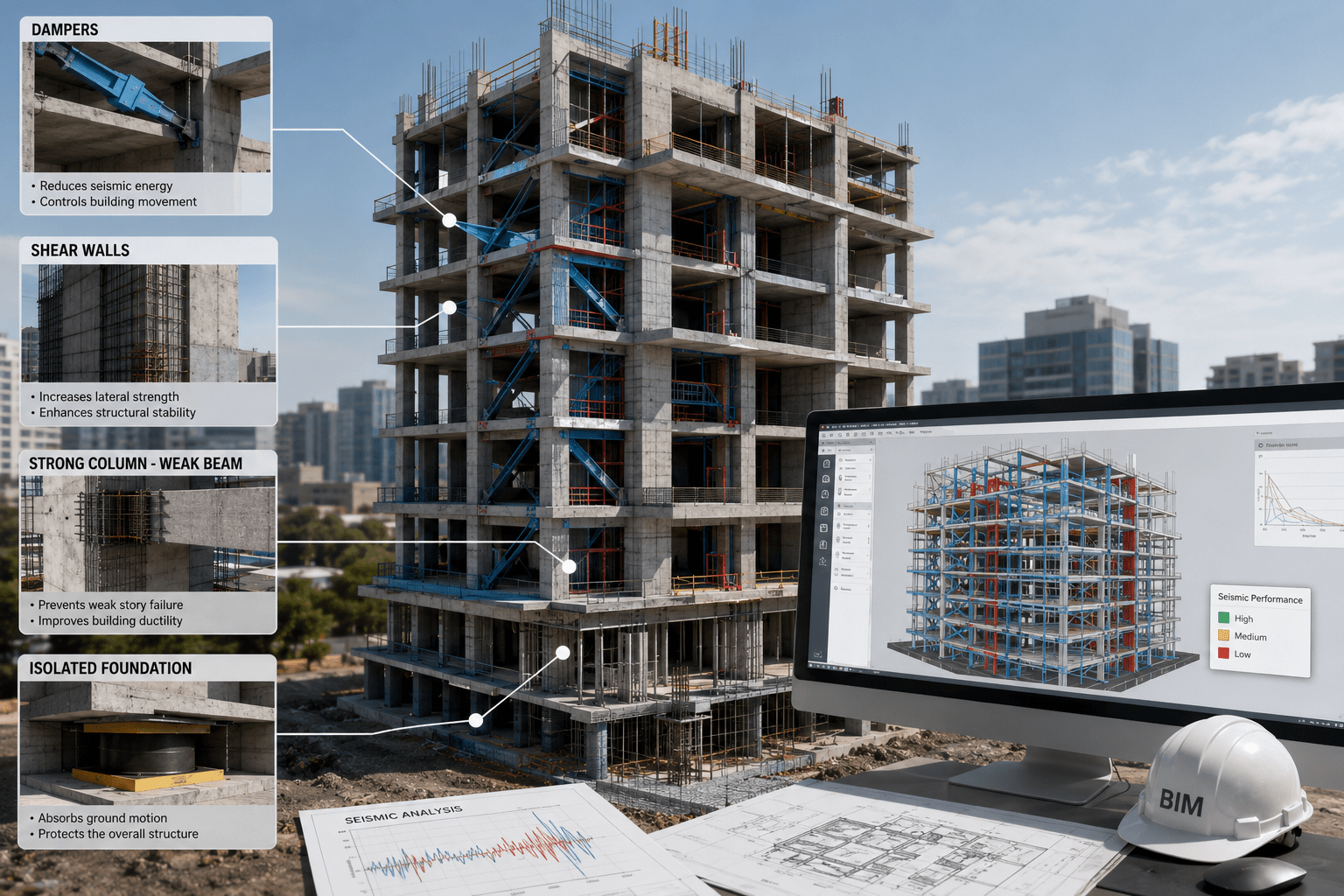
By leveraging BIM’s capability, engineers can design beautiful buildings that offer many advantages in terms of earthquake resistance.
BIM’s structural analysis tools allow engineers to model seismic load paths, detect stress concentration points, and optimize reinforcement placement ahead of construction. Consequently, occupant risk from structural failure is reduced.
Coordinated BIM models integrate architectural, MEP, and structural systems to ensure that seismic design choices are fully addressed across all disciplines.
BIM-coordinated documentation diminishes field errors and design conflicts, compressing construction timeframes. This is particularly critical for post-seismic reconstruction projects where speed explicitly impacts community recovery.
Early spotting of structural conflicts and material optimization using BIM’s quantity takeoff tools lowers rework expenses and eliminates over-specification of seismic reinforcement elements.
Earthquakes are sudden and violent tremors of the Earth. They pose a constant threat to property and life. While earthquake-proof might seem ideal, the reality is far more nuanced. Engineers face multiple challenges when designing structures that can withstand these powerful events. Let us understand these complexities:
Earthquakes are unpredictable. Their period, location, and intensity vary significantly, making it impossible to design a single structural solution that deals with every seismic scenario. Engineers must evaluate various seismic frequencies and magnitudes to balance structural efficacy and cost.
The foundation of a building is essential during an earthquake. Different types of soil react differently to shaking the ground. Loose or soft soil can amplify the shaking, while other soils might provide a more stable base. Regardless, understanding the soil classification at the construction site is crucial for developing the foundation and prevalent design.
While the primary system is essential, non-structural components like cladding, ceilings, and partitions pose security threats if not properly attached. These elements detach and become dangerous projectiles during an earthquake. Nevertheless, embedding these elements into the overall structural strategy and ensuring they are securely connected is essential for residents’ security.
Basic earthquake-resistant design involves using durable materials and applying advanced engineering methods. These factors significantly increase the cost of construction. Therefore, counterbalancing security and affordability in areas with greater seismic risk is a real challenge.
Many existing buildings are not designed for earthquake resistance. Retrofitting enhances seismic performance but is costly and complex. Therefore, architects must carefully consider the current design and its restrictions before executing appropriate retrofitting techniques.
Designing earthquake-resistant buildings is a critical and ongoing challenge, especially in seismically active regions. While absolute earthquake-proofing may not be attainable, innovative tools like Building Information Modeling (BIM) make creating safer, more resilient structures significantly more feasible. BIM improves collaboration, optimizes structures, and streamlines building, all while lowering expenses and time. By embracing this digital transformation, architects and engineers can improve structural performance and ensure the safety and well-being of communities. The fusion of BIM and seismic design principles represents a decisive step forward in modern construction.
uppteam’s BIM and structural design teams integrate seismic evaluation, real-time model coordination, and multidisciplinary documentation operations to help AEC firms deliver earthquake-resistant designs that fulfill code requirements and shield occupant safety.
Schedule a consultation today and discuss your project’s seismic design support needs.