Architectural Services
Balancing Sustainability and Performance: The Role of Synthetic Materials in AEC Design
-
 Soumen
 - May 30, 2025
- 7:04 am


U.S.-based local architectural representation, ensuring communication, accountability, and delivery expectations, managed close to the client.
Explore more
Discover our architectural design excellence through a curated selection of projects.
Explore more
Take a look at how Uppteam can elevate your projects with expert engineering solutions.
Explore more
Our Structural Support Services can enhance your structural engineering projects with expert support.
Explore more
Uppteam delivers precise and reliable surveying and mapping solutions to help you make informed decisions.
Explore more
Whether you're working on residential, commercial, or industrial buildings..
Explore more
Uppteam’s Virtual Admin Support can help you with all your administrative tasks..
Explore more
Our experts work as your Second Eye Services expert.
Explore more Soumen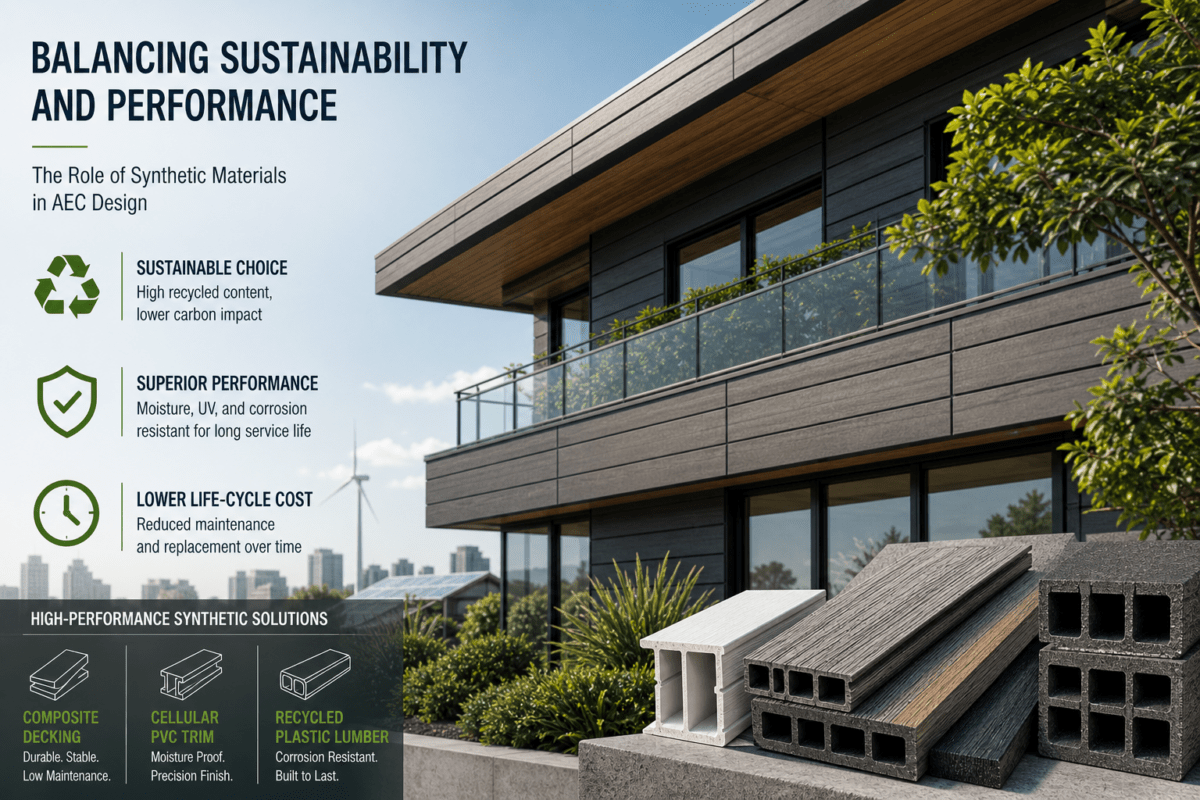
Walking through the construction site of Denver International Airport’s recent terminal expansion, you will notice something telling: nearly every exterior trim piece is synthetic. Not because it is cheaper—it isn’t—but because the project’s LEED Platinum certification demands materials with verifiable environmental credentials and 50-year performance guarantees.
This scene reflects a broader shift across the AEC industry. Sustainability has evolved from a nice-to-have checkbox into a fundamental design constraint. The numbers tell the story: construction materials account for approximately 11% of global CO2 emissions, with traditional building materials contributing around 107 kg CO2e per square meter in residential construction, according to recent research published in Frontiers.
Today’s engineered synthetic alternatives like composite decking, cellular PVC trim systems, and HDPE lumber technically resonate barely with early-generation vinyl products. The performance specifications have changed from their core, and so has the sustainability calculus.
Chinmay Jha, a materials expert at uppteam, puts it bluntly: “We’re not choosing between good and bad anymore. We’re optimizing between different types of trade-offs.”
The synthetic materials landscape has fragmented into highly specialized products, each targeting specific performance gaps. Here’s what the data reveals:
Contemporary composite decking, such as Trex, consists of 95% recycled materials—primarily repurposed polyethylene and recycled wood fibers sourced from shopping bags and food packaging. The material science is impressive: wood fiber provides structural integrity while plastic creates weather resistance.
However, here’s the kicker—researchers at the American Chemical Society have recently developed a carbon-negative composite decking that stores more CO2 during its lifecycle than is required for manufacturing. Early prototypes sequester approximately 1.8 kg of CO2 per square foot over a 25-year lifespan.
Performance Specifications:
Cellular PVC trim boards address a specific issue: the vulnerability of traditional wood trim to moisture infiltration around windows and doors. The material’s closed-cell structure eliminates water absorption, a critical factor in building envelope performance.
James Morrison, a specifications writer at Perkins+Will, explains: “We’ve documented moisture-related callbacks dropping by 78% on projects where we specify cellular PVC for trim applications. That’s not just durability—it’s risk management.”
Performance Specifications:
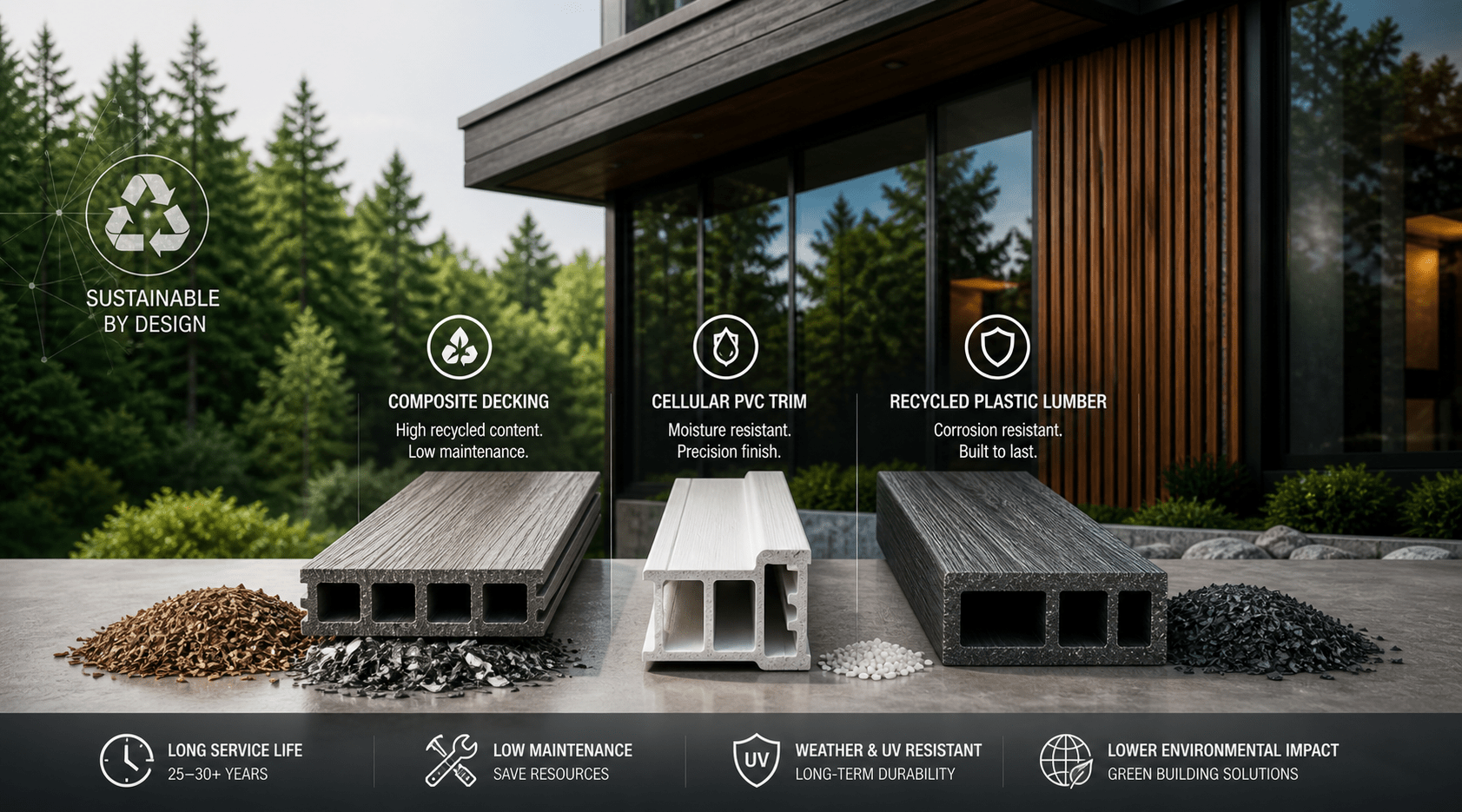
High-density polyethylene (HDPE) lumber is designed for applications where wood typically fails, such as marine environments, playground equipment, and industrial installations. The material’s chemical inertness makes it ideal for corrosive environments.
A case study from the Port of Long Beach’s recent pier reconstruction illustrates the economics: HDPE lumber costs 40% more upfront than treated wood but eliminates the need for replacement over the project’s 30-year design life, resulting in a 60% lower total cost of ownership.
Skanska USA recently completed the 18-story Ascent Tower in Milwaukee—the world’s tallest mass timber residential building. While the structure uses CLT (cross-laminated timber), the building envelope relies heavily on synthetic components.
“We used composite cladding systems for 65% of the exterior,” explains project architect Tim Gokhman. “The decision came down to fire performance and maintenance. Wood cladding would require treatments that conflict with our sustainability goals.”
The project’s material breakdown:
A lifecycle assessment showed that the hybrid approach reduced embodied carbon by 23% compared to all-wood cladding while meeting fire safety requirements.
California’s Title 24 energy code updates have created unexpected consequences for material selection. The 2022 revisions emphasize whole-building performance, not just individual component efficiency.
Michael Rodriguez, principal at Gensler’s Los Angeles office, describes the shift: “We’re seeing clients choose synthetic materials specifically because they can model their long-term performance with confidence. Wood’s variability makes energy modeling complicated.”
The numbers support this trend: projects using predominantly synthetic exterior materials showed a 12% better correlation between predicted and actual energy performance in post-occupancy evaluations.
Total Cost of Ownership Models
Recent analysis from Dodge Construction Network reveals the accurate cost picture. Their 2024 report tracked 150 commercial projects over 10 years:
Synthetic Materials Average:
Critical Break-Even Points:
Labor Efficiency Factors
Synthetic materials often provide unexpected labor savings. The plastic decking market is projected to grow from $5.66 billion in 2024 to $12.30 billion by 2032, with a 10.18% compound annual growth rate (CAGR), driven partly by increased installation efficiency.
Contractors report 25-30% faster installation times for synthetic materials due to:
Lifecycle Assessment Data Points
The conversation about carbon footprint is more complex than often portrayed. Recent LCA studies from the University of Washington reveal:
Production Phase:
Use Phase (25-Year Analysis):
End-of-Life:
The crossover point where synthetics become environmentally favorable occurs around years 7-9 for most applications.
Emerging Bio-Based Innovations
The next generation of synthetic materials is addressing concerns about recyclability. Companies like NewTechWood are developing composite systems that use agricultural waste, such as rice hulls and wheat straw, as filler materials.
These bio-composites offer:
Building Information Modeling has revolutionized how teams evaluate material trade-offs. Autodesk’s recent AEC Collection updates include integrated LCA tools that calculate environmental impact in real-time as designers modify materials.
“We can now run ‘what-if’ scenarios instantly,” says Jennifer Park, BIM manager at HOK. “Change the cladding material, and immediately see the impact on embodied carbon, cost, and maintenance schedules.”
IoT sensors embedded in synthetic materials are providing unprecedented performance data. A pilot program at UC San Diego’s campus monitored composite decking performance over three years, measuring:
This data is feeding machine learning algorithms that predict maintenance needs with 89% accuracy, enabling proactive rather than reactive building management.
The AEC industry’s focus on digitalization, AI, and sustainability is driving innovation in prefabrication. Synthetic materials align perfectly with off-site construction requirements:
Dimensional Stability: Factory-controlled environments demand materials that won’t warp, shrink, or expand unpredictably. Synthetics’ engineered consistency enables tight tolerances impossible with natural materials.
Transportation Efficiency: A recent Factory OS project in California reduced shipping costs by 30% by switching from wood to synthetic cladding systems, primarily due to weight savings and stackability.
Quality Control: The predictable properties of synthetic materials enable automated quality assurance systems to detect defects before installation.
Research labs are developing breakthrough synthetic materials:
Carbon Fiber Composites: University of Michigan researchers created wood-fiber/carbon-fiber hybrid materials with 300% higher strength-to-weight ratios than traditional wood.
Smart Synthetics: Materials embedded with phase-change materials that regulate building temperature, reducing HVAC loads by up to 15%.
Self-Healing Polymers: Early-stage materials that can repair minor damage autonomously, potentially extending service life to 50+ years.
Leading firms are developing systematic approaches to material selection:
Material choices vary significantly by climate zone:
Hot, Humid Climates (Southeast US): Synthetic materials offer clear advantages due to their resistance to moisture and insects.
Cold Climates (Mountain West): Thermal expansion becomes a critical factor; some synthetics require exceptional detailing.
Seismic Zones (West Coast): Lightweight synthetics reduce seismic loads but require careful connection design.
The synthetic materials spectrum has fragmented into numerous specialized product categories. Each one comes with distinct LCA profiles, performance envelopes, and specification requirements. The real challenge for AEC firms is not awareness anymore; it is actually having the design and documentation capacity and proficiency to assess trade-offs rigorously and share them clearly with clients, contractors, and code reviewers.
uppteam’s architectural design and BIM experts integrate directly into your project workflows. Our team explicitly provides material visualization, BIM-embedded sustainability analysis, lifecycle cost documentation, and prefabrication-ready detailing. We take care of all of these from the early SD phase through permit-ready construction sets.
uppteam delivers the technical expertise and documentation precision your team always searches for without the overhead of increasing internal capacity. Be it that your project requires photorealistic weathering visualizations to settle client material concerns, live BIM-connected LCA modeling as cladding choices evolve, or synthetic material detailing for off-site constructions, our team integrates directly into your operations at the scope and speed your project demands.
The synthetic materials will only grow more complex as bio-composites, smart polymers, and self-healing materials enter the mainstream AEC market. So, firms need to set up systematic material evaluation workflows now, anchored in LCA data, total cost modeling, and BIM-integrated analysis. This will help those firms carry a quantifiable benefit in sustainable project delivery.
Partner with uppteam to ensure that your documentation and design processes are made to deal with that complexity at scale.